

A close examination of the Hebrew spelling error printed on the cover of the “Yahvah” Sacred Name Bible associated with Professor Hannes Redelinghuys.
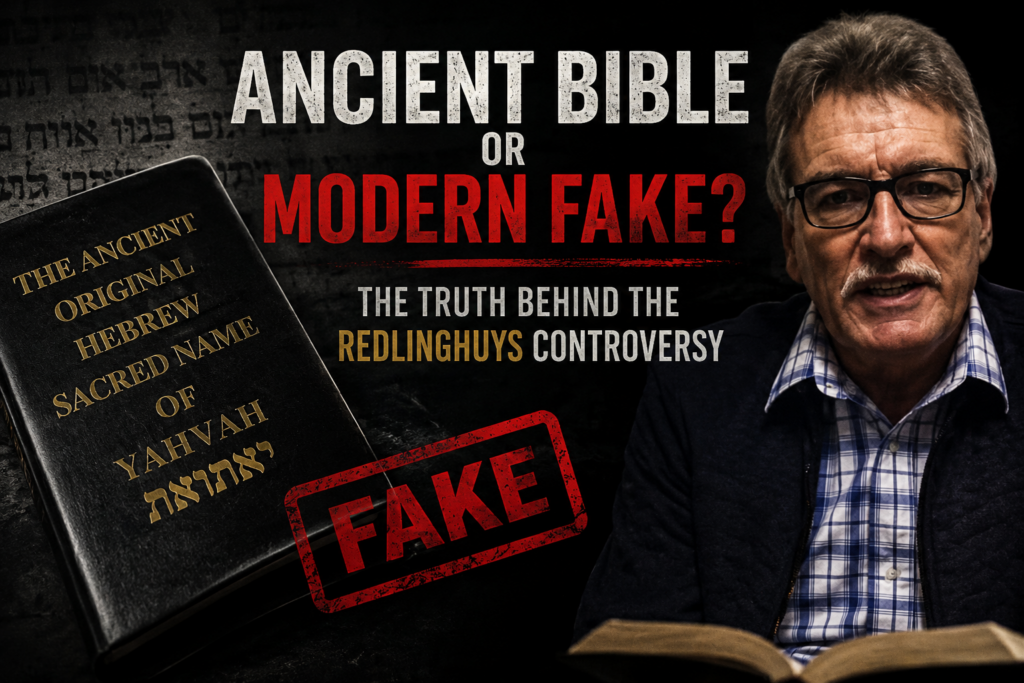
The Restoration of the Original sacred name Bible, which Professor Hannes Redelinghuys rebranded as “The Ancient Original Hebrew Sacred Name of YAHVAH”. With this Bible , Professor Hannes Redelinghuys claims to restore an ancient Hebrew sacred name, but the Hebrew on its cover spells “YATVAT” instead. Here follows a photographic examination of the error.
A Bible that claims to restore the ancient original Hebrew sacred name of God should, at the very least, print that Hebrew correctly. Yet the cover examined in this article contains a remarkable problem.
Above the Hebrew text, the book boldly identifies the sacred name as:
YAHVAH
But the Hebrew letters printed directly beneath it contain an obvious error. And this is not a debate about whether the divine name should be pronounced Yahweh, Yahvah, Jehovah, or something else. The problem is much simpler.
The Hebrew printed on the cover does not say what the English text above it claims it says.
The Name Printed on the Cover

The cover reads:
THE ANCIENT ORIGINAL HEBREW SACRED NAME OF YAHVAH
Directly beneath the word YAHVAH, a Hebrew spelling is printed.
At first glance, most English-speaking readers would probably assume that the Hebrew simply confirms the English word above it. But anyone familiar with the Hebrew alphabet should immediately notice a problem.
The final Hebrew character printed on the cover is:
ת = Tav
That letter is called Tav. It represents a T sound.The letter required for the final H in the name Yahvah would instead be:
ה = He
That letter is called He. These are not two slightly different versions of the same character. They are completely different Hebrew letters.
ת = Tav
ה = He
The difference matters.
The Error Is Visible on the Cover
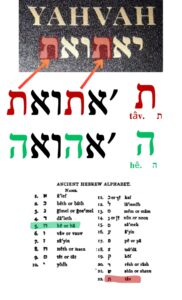
This is not a complicated theological argument. It is not a dispute between different denominations. It is not a matter of personal interpretation. The book itself presents an English name and then prints Hebrew beneath it. The two do not match. The English says:
YAHVAH
Yet the final Hebrew letter printed beneath it is Tav — ת.
A Tav does not represent the final H in Yahvah.
The Hebrew character expected there would be He — ה.
That means the error can be demonstrated simply by comparing the printed character with the Hebrew alphabet. The Hebrew letter Tav (ת) is the 22nd letter of the Hebrew alphabet. It does not have a direct equivalent in English, but it is often transliterated as “T” or “TH”. The Hebrew letter Hey (ה) is the fifth letter of the Hebrew alphabet. It is pronounced as a voiceless glottal fricative (/h/) and is often transliterated as “H”. If we were to pronounce the word with the error it would be pronounced “Yatvat“.
The Insertion of Two Alephs (א):
Another troubling error was the insertion of two alephs (א) in the spelling of “Yahvah.” Aleph, while silent in many contexts, is not part of the original divine name and does not belong in the sequence. The divine name in Hebrew is composed of four specific letters, and altering it in such a way undermines the accuracy and reverence of the text.
The professor’s intention may have been to restore the “correct” usage of the divine name in English and Hebrew, but these mistakes only lead to confusion and misrepresentation. In fact, this example underscores the importance of scholarship and precision, especially when dealing with sacred texts. If a project seeks to restore the sacred name of God, it must do so with the utmost care and respect for the original languages
Why This Error Is Significant
Every publication can contain a typo. A spelling mistake in an ordinary book would normally be nothing remarkable. But context matters. This is a book whose cover specifically claims to present:
“THE ANCIENT ORIGINAL HEBREW SACRED NAME”
The Hebrew name is not a minor detail hidden somewhere in the book. It is the central claim of the cover itself. That is why the mistake matters.
Professor Hannes Redelinghuys asks the reader to trust its accuracy concerning the ancient Hebrew sacred name while displaying an incorrect Hebrew character in the very name he is presenting.
That is not a minor punctuation error.
It is an error involving the central subject of the cover.
When presenting sacred texts, particularly those claiming to restore the original names of God,accuracy is not just important, it’s essential. Hebrew, like all ancient languages, carries significant theological and cultural weight. A single letter can change the entire meaning of a word. In this case, the substitution of Tav for Hey and the addition of unnecessary Alephs create an entirely new and unintended word that could mislead readers about the nature of the divine name.
The Manually Altered Copy
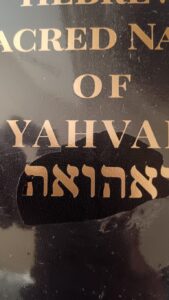
The story becomes even more interesting when examining another photographed copy of the book.
A photograph supplied in connection with this investigation appears to show the incorrect printed character manually altered in dark ink so that it more closely resembles the intended Hebrew letter.
Instead of correcting the mistake through proper means, the publisher chose to amend it with a black marker. This makeshift solution not only undermines the credibility of the text but also raises concerns about the integrity and diligence of those handling such important materials. This incident highlights the importance of careful scholarship and respect for the accuracy of sacred texts, urging us to critically evaluate and seek reliable translations.
Why Accuracy Matters
When a publication makes strong claims about ancient languages, readers are entitled to examine those claims carefully.
Hebrew is not mystical code accessible only to a small group of teachers. Its letters can be identified. Its texts can be examined. Its spelling can be checked. And claims about it can be tested. That is especially important when someone claims to possess or restore an “ancient original Hebrew sacred name.”
The stronger the claim, the greater the responsibility to get the evidence right.
Conclusion
The issue examined here is narrow and verifiable. The cover claims to present the:
“ANCIENT ORIGINAL HEBREW SACRED NAME OF YAHVAH.”
Yet the Hebrew printed beneath that claim contains a Tav — ת where the final He — ה would be required to match the name Yahvah.
Those are different Hebrew letters. The distinction is visible. The error can be checked by anyone familiar with the Hebrew alphabet.
The evidence is sufficient on its own. For a publication built around the accurate restoration of a Hebrew sacred name, the best response would be simple:
Acknowledge the error. Correct it. And ensure that future copies reproduce the Hebrew accurately.
Until then, the photograph remains.
And the letters speak for themselves.
‘The Restoration of the original sacred name‘ bible is printed and distributed locally by Professor Hannes Redelinghuys (B.Div.) (M.Div.) (Ph.D.)(Eskat.) (Calvary Univ.), from the first assembly of Yahvahshua South Africa. If you’d like to get in contact with Professor Hannes, please visit his website: yahvah.co.za and yahvahshua.co.za
Disclaimer:
I’d love to hear your thoughts! Feel free to share your questions, insights, or reflections in the comments below as we engage in this journey of exploring and defending the Christian faith together.
As a Christian apologetics platform, we encourage thoughtful and respectful dialogue. Please refrain from any form of harassment, mockery, or disrespect toward individuals mentioned in these posts.
Our goal is to engage in conversations with kindness, humility, and a spirit of understanding. Let us reflect Christ’s love in our words and actions.