
The form “Yahvah” is not established by the Hebrew spelling יהוה, the manuscript evidence, or the standard historical reconstruction of the divine name. This does not mean that every question about the ancient pronunciation is settled. It means that a proposed pronunciation must be distinguished from demonstrable Hebrew spelling.
SOLA VERITAS Library ID: #SOLAVERITAS0003
Key distinction: the four written Hebrew consonants are evidence; a modern insertion of vowels is a reconstruction. “Yahvah” should therefore be presented as a modern proposal, not as an uncontested restoration.
What is actually written in Hebrew?
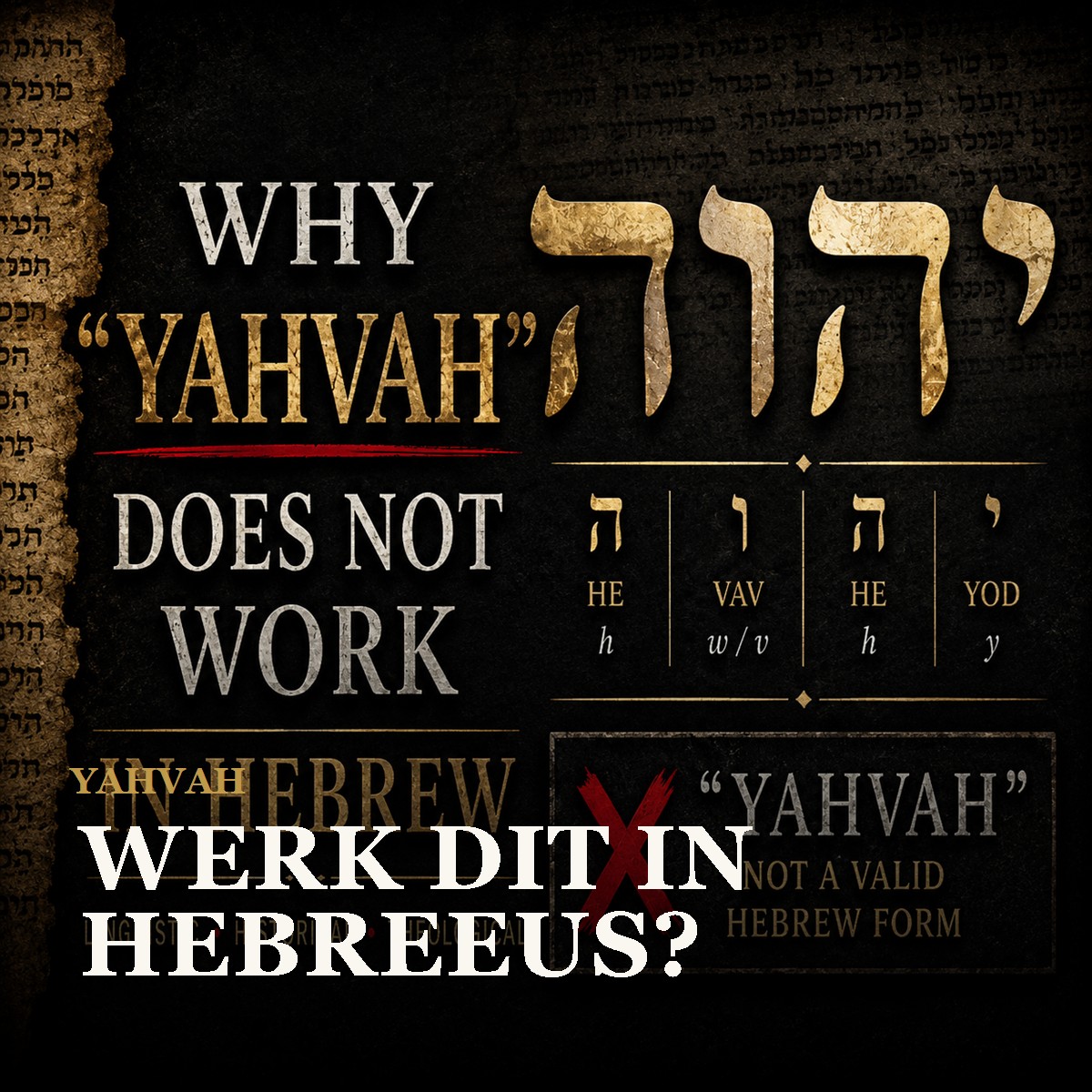
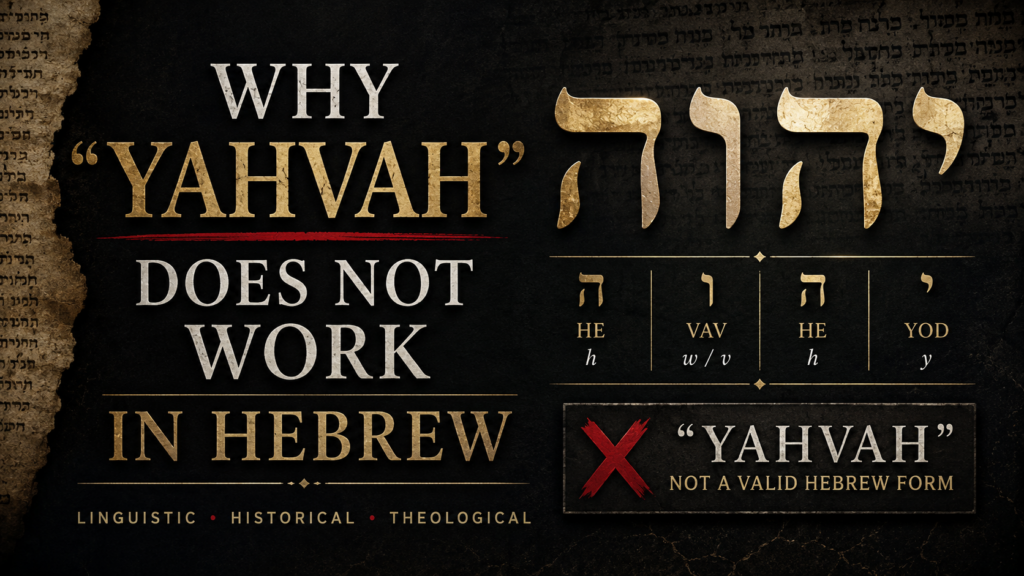
The divine name in the Hebrew Bible is written with four consonants: יהוה—yod, he, waw, he. This four-letter form is conventionally represented as YHWH and called the Tetragrammaton. The official Unicode Hebrew chart independently identifies the relevant Hebrew letters and prevents visual look-alikes from being treated as interchangeable characters.
Ancient Hebrew writing did not record vowels in the same way as later fully pointed Masoretic texts. The consonants establish the written form, but they do not by themselves supply a complete ancient pronunciation. That limitation matters: one cannot simply insert preferred vowels and then claim that the result is visibly “the original Hebrew name.”
Spelling and pronunciation are different questions
In English transliteration, the Hebrew letter waw is represented by either w or v, depending on the historical period and the transliteration system. Consequently, writing YHVH instead of YHWH does not by itself establish the vowels in “Yahvah.” Both forms are consonantal representations.
The decisive question is therefore not whether a modern reader can arrange the Latin letters Y-H-V-H around the vowels in “Yahvah.” The question is whether ancient Hebrew forms, early transcriptions, theophoric names and manuscript traditions support that particular vocalisation. The evidence usually discussed in scholarship supports forms related to Yah, Yahu and the conventional scholarly reconstruction Yahweh; it does not establish “Yahvah” as a uniquely restored form.
What the manuscript evidence can show
The Dead Sea Scrolls preserve the Tetragrammaton in several scribal forms. The Israel Antiquities Authority notes, for example, that the divine name is sometimes written in Paleo-Hebrew characters while the surrounding text uses the later square script. See the Leon Levy Dead Sea Scrolls Digital Library example.
This evidence is significant for the reverence and visual treatment of the written name. It confirms the consonantal identity of the name, but it does not print the modern vowel sequence “a-a” required by “Yahvah.” Manuscript spelling and reconstructed pronunciation must therefore remain separate parts of the argument.
Why scholars commonly write “Yahweh”
“Yahweh” is a scholarly reconstruction rather than a surviving audio recording. It draws on several lines of evidence, including shortened forms in Hebrew names, ancient Greek transcriptions and comparison with Semitic language patterns. Accessible discussions include Encyclopaedia Britannicaʼs overview of Yahweh and the academically edited TheTorah.com discussion of YHWH.
Responsible wording still matters. The original pronunciation is reconstructed, and details of its etymology remain debated. It is therefore more accurate to say that “Yahweh” is the dominant scholarly reconstruction than to pretend that every aspect is beyond discussion. That uncertainty, however, does not supply positive evidence for “Yahvah.” A gap in our knowledge cannot be used as proof for one preferred modern form.
The problem with an exclusive sacred-name claim
A movement may choose “Yahvah” as a devotional pronunciation. The stronger claim—that this form alone restores the ancient Hebrew and that other Christians use a false name—requires historical and linguistic evidence. The Hebrew consonants do not encode that conclusion, and the cited manuscript record does not uniquely point to it.
The burden of proof becomes even greater when salvation, spiritual legitimacy or doctrinal authority is attached to one disputed vocalisation. Biblical theology does not present redemption as the reward for reconstructing a lost vowel pattern. The identity, character and saving action of God cannot be reduced to a modern transliteration test.
“Yahvah” in Sacred Name publishing
The form has appeared in a small stream of Sacred Name material, including the Restoration of the Original Sacred Name Bible. Its appearance in a modern publication proves that the editors adopted the form; it does not independently establish the pronunciation in ancient Hebrew.
For a detailed examination of that publicationʼs history, contents and claims, read The Restoration of the Original Sacred Name Bible: A Critical Academic Review. For the separate lettering controversy on a locally distributed cover, see The Hebrew Spelling Error on the “Yahvah” Bible and the documented response from Hannes Redelinghuys.
Conclusion
The strongest defensible conclusion is precise rather than sensational: “Yahvah” is not demonstrated by the consonantal Hebrew יהוה and is not the standard historical reconstruction of the divine name. It may function as a modern confessional pronunciation, but it should not be presented as though the Hebrew letters themselves settle its vowels or prove its exclusivity.


[…] reflect the sacred name of God (YHWH), so they modify it to Yahvahshua to more explicitly reference Yahvah. However, this combination is neither linguistically accurate nor historically […]