
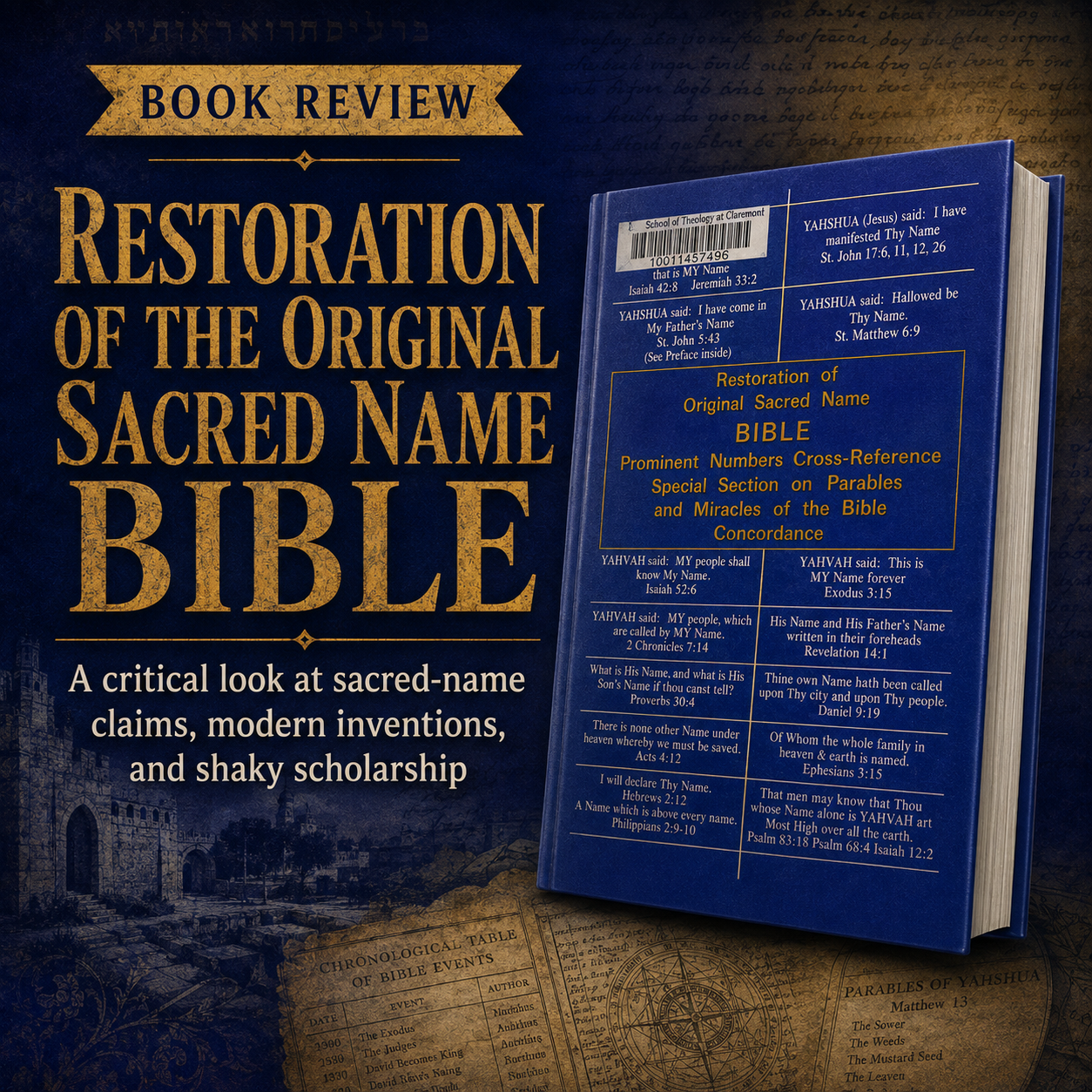
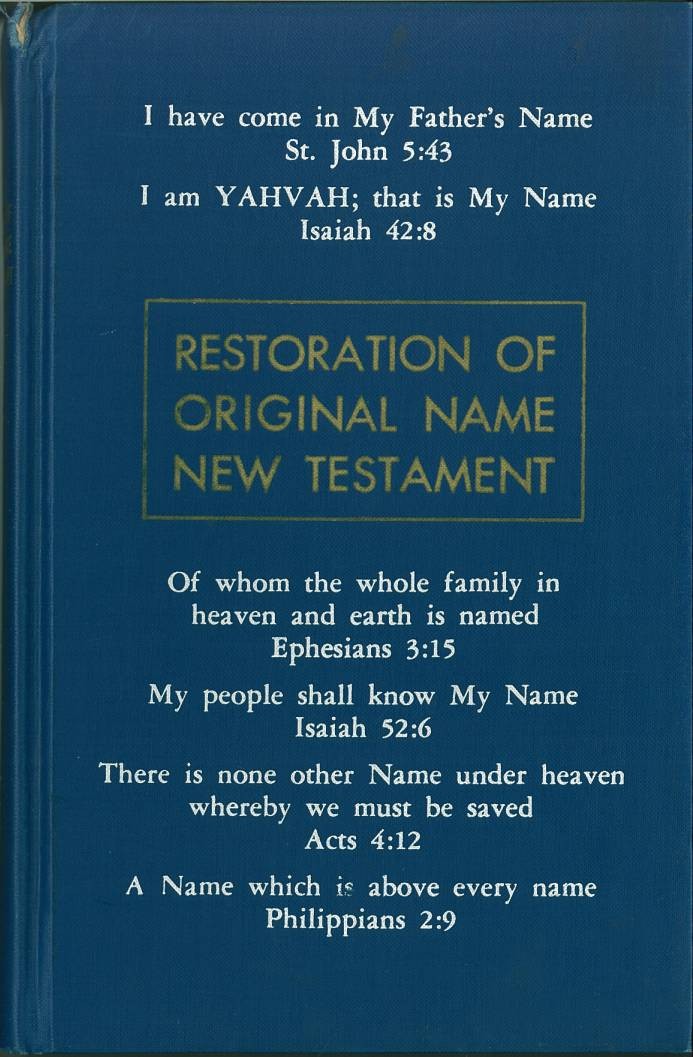
Short verdict: The Restoration of Original Sacred Name Bible (ROSNB) is not an academically credible restoration of the original biblical text. It is substantially J. B. Rotherham’s Emphasized Bible with names and titles replaced by forms preferred by its editors. “Yahvah,” “Yahshua” and especially “Yahvahshua” are not readings recovered from ancient biblical manuscripts. The first is a marginal vocalisation of YHWH; the latter two are modern reconstructions, with “Yahvahshua” lacking a defensible place in historical Hebrew. In the New Testament these substitutions override the surviving Greek evidence rather than translate it.
What kind of Bible is it?
The ROSNB describes its purpose in its title: to restore the names of the Father and the Son to Scripture. Its preface identifies the work as a revision of Rotherham’s translation. That distinction matters. A fresh translation normally begins with defined Hebrew, Aramaic and Greek base texts and explains how textual variants and translation choices were handled. The ROSNB instead inherits most of its English wording and much of its translation character from Rotherham, while systematically altering names and titles.
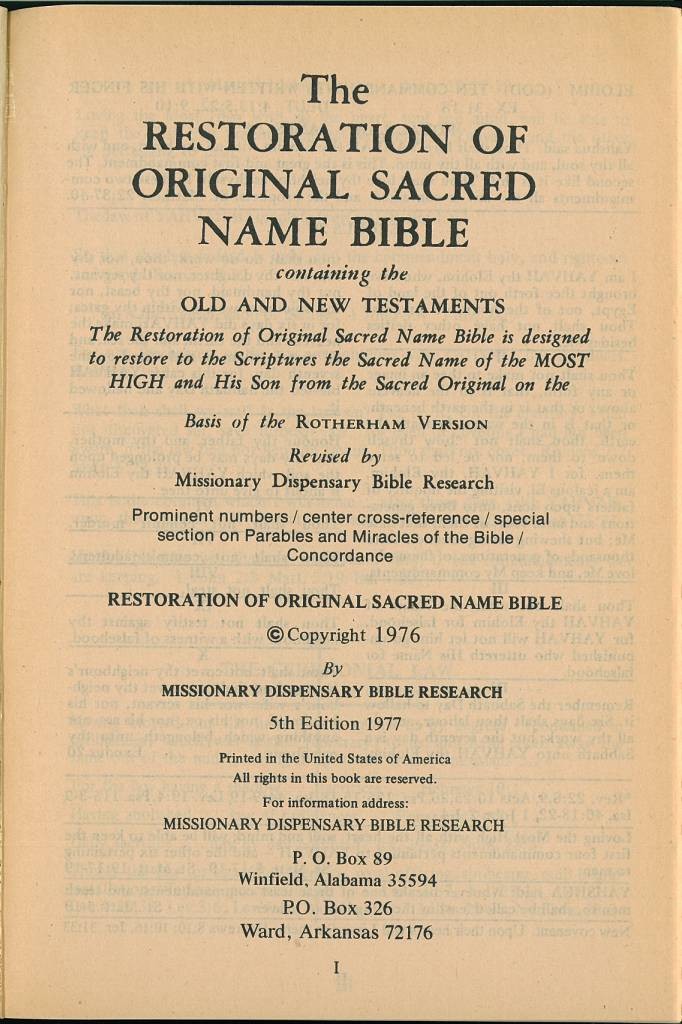
Rotherham’s Emphasized Bible was a serious late nineteenth-century translation. It is unusually formal, preserves literary emphasis through a complex typographical system and renders the Tetragrammaton as “Yahweh” in the Hebrew Bible. The ROSNB therefore begins with a more scholarly base than a simple King James Version word-substitution project. Yet the scholarship belongs principally to Rotherham; the ROSNB’s distinctive editorial contribution lies in its sacred-name revisions.
The principal features
- YAHVAH is used for the four Hebrew consonants יהוה (YHWH), where most English Bibles print “LORD” in small capitals and Rotherham used “Yahweh.”
- Elohim frequently replaces “God,” carrying a Hebrew term into English rather than translating it.
- Yahshua, with a longer form Yahvahshua in a small number of places, replaces “Jesus.”
- Messiah replaces “Christ,” and titles such as “Master” may replace “Lord.”
- Most of Rotherham’s formal, sometimes demanding English style remains.
These choices make the book immediately distinctive. They also reveal its governing philosophy: Hebrew forms are treated as spiritually and historically preferable to conventional English and Greek-derived forms.
A borrowed translation with substituted names
The charge that the ROSNB “hijacks” another translation should be expressed precisely. Its editors did acknowledge Rotherham on the title page, so the dependence was not concealed. Nevertheless, the finished work contributes very little independent translation. Sentence structure, vocabulary, punctuation and Rotherham’s unusual system of emphasis remain in place, while selected divine names and titles are replaced. Calling the result a “restoration” gives these substitutions a textual authority they have not earned.
Physical copies make the revision process unusually visible. In passages examined by critics and owners, forms such as “YAHVAH,” “YAHSHUA” and “YAHVAHSHUA” can appear in type that does not match the surrounding line. A font change alone cannot settle a linguistic argument, but here it corroborates what the title page already admits: an existing typeset translation was altered at selected words. The method is substitution, not fresh translation from Hebrew and Greek.
Where the ROSNB is strongest: the Hebrew Bible
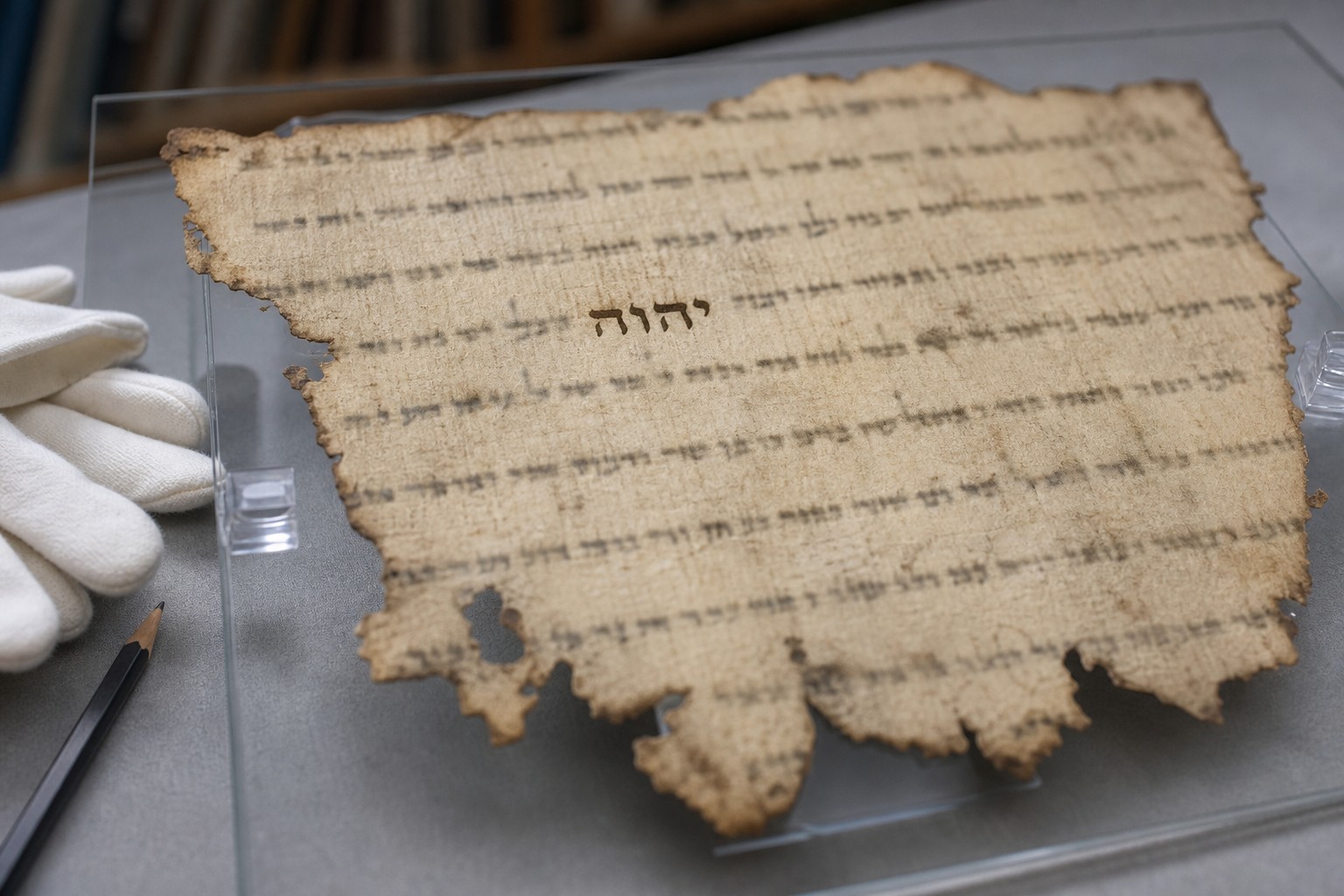
The case for showing the divine name in the Old Testament is substantial. The consonants YHWH are present thousands of times in the Masoretic Text. Printing “LORD” follows a long Jewish reading tradition and later Christian convention, but it obscures the visible distinction between YHWH, adonai (“lord”) and other titles. A reader of the ROSNB cannot easily miss the centrality of God’s personal name in Exodus, the Psalms and the prophets.
This can improve close reading. Repetitions of “the name of YHWH,” wordplay involving divine names and passages that contrast YHWH with other deities become more obvious. On this point the ROSNB belongs to a respectable minority tradition. Several translations outside the Sacred Name movement have also printed “Yahweh” or a comparable form.
The difficulty is not whether יהוה is in the Hebrew text; it plainly is. The difficulty is pronunciation. “Yahweh” is the most common scholarly reconstruction, though complete certainty is impossible. “Yahvah” has far less support in mainstream Hebrew linguistics. The ROSNB may use it as a faith-community convention, but calling that vocalization the demonstrably original pronunciation goes beyond the available evidence.
Stated more directly: no recognised academic consensus reconstructs יהוה as “Yahvah.” The form is produced within a small religious tradition and then inserted into an older English translation. It should not be presented to readers as though archaeologists or Hebrew philologists recovered the spelling from an ancient manuscript.
Elohim: informative, but not always translation
Retaining Elohim can remind readers that Hebrew uses several words commonly flattened into the English “God.” That is useful in a study tool. In a continuous English translation, however, transliteration is not automatically greater accuracy. Elohim is a Hebrew common noun whose meaning depends on grammar and context; it may refer to Israel’s God, other gods or heavenly beings. Transliteration transfers the form, but leaves the interpretive work to the reader.
The method becomes still harder to justify when Hebrew vocabulary is inserted into New Testament passages whose surviving text is Greek. Greek theos means “God” or “a god” according to context; replacing it with Elohim creates a Hebrew colouring not present in the extant Greek manuscripts.
The New Testament is the central problem
No known extant Greek New Testament manuscript contains the Tetragrammaton in its continuous text. The manuscripts use forms of theos (“God”) and kyrios (“Lord”), often written as sacred-name abbreviations known as nomina sacra. Some ancient Greek copies of the Jewish Scriptures preserved YHWH in Hebrew characters, so scholars continue to study how Jewish and Christian scribal practices developed. That fact, however, does not establish that the autographs of the New Testament contained YHWH, much less a specific vocalization such as “Yahvah.”
Consequently, inserting a sacred-name form into the New Testament is an editorial reconstruction based on a theological and historical argument, not a reading directly attested in the surviving Greek New Testament manuscript tradition. A transparent edition should signal such insertions typographically or in notes. Presenting them without consistent annotation can cause readers to confuse a hypothesis with manuscript data.
Yahshua and Yahvahshua
The historical name behind English “Jesus” is connected to Hebrew/Aramaic Yeshua, a shortened form related to Yehoshua (Joshua). The Greek New Testament writes Ἰησοῦς (Iēsous), the established Greek form also used in the Septuagint for Joshua. Using a Semitic form in an English Bible can help readers recover Jesus’ Jewish setting, but “Yahshua” is not the only possible reconstruction and is not the standard form in historical linguistics.
The longer “Yahvahshua” is more problematic. It is not securely attested as the historical personal name of Jesus and depends upon the ROSNB’s preferred reconstruction of the divine name. The edition’s inconsistent movement between “Yahshua” and “Yahvahshua” also weakens its stated purpose: if one form is genuinely original, readers need a philological explanation for why the other appears in most passages.
In academic terms, “Yahvahshua” is not a viable original form. “Yahshua” is also not the normal scholarly reconstruction of Jesus’ historical name; Yeshua is the widely attested Second Temple-period form. English “Jesus” is not a pagan corruption but the conventional English descendant of Greek Ἰησοῦς, itself the form used by the Greek Bible for Hebrew names such as Joshua. Replacing the manuscript reading with a modern sacred-name form reverses the normal direction of textual criticism: the desired theology determines the wording.
Major criticisms
- No manuscript basis for the signature forms: “Yahvah” and “Yahvahshua” are not readings found in the Hebrew or Greek witnesses on which critical editions are based.
- New Testament names are inserted, not translated: the extant Greek reads forms such as kyrios, theos and Iēsous. The ROSNB replaces them according to a doctrinal programme.
- Dependence on Rotherham: most of the actual English translation is Rotherham’s work. The new editors did not produce an independently documented translation from source texts.
- Visible editorial patching: mismatched type in some copies makes the substituted names look mechanically inserted, reinforcing the underlying textual comparison.
- Inconsistent name theory: “Yahshua” and “Yahvahshua” are both used even though the project claims to restore one original name.
- Hebrew vocabulary imposed on Greek: replacing Greek theos with Elohim creates a Hebraic surface that is not present in the manuscript being translated.
- Insufficient scholarly accountability: there is no transparent critical apparatus, recognised translation committee, peer-reviewed defence of the vocalisations or verse-by-verse documentation of conjectural changes.
Messiah and Christ
Replacing “Christ” with “Messiah” is defensible as an explanatory choice. Greek christos and Hebrew/Aramaic mashiach both concern an “anointed one.” “Messiah” can prevent modern readers from treating “Christ” as a surname. Yet a translation should also show that the New Testament authors actually wrote Greek and sometimes exploited Greek vocabulary. Uniformly Hebraizing the text may illuminate its Jewish background while simultaneously concealing its Greek literary form.
Readability and literary style
Readers who appreciate formal equivalence may value the ROSNB’s closeness to Rotherham. Its syntax often exposes relationships that smoother paraphrases conceal. The emphasis markings inherited from Rotherham can reward careful study.
The cost is readability. The English is dated, punctuation-heavy and sometimes awkward aloud. It is not the best first Bible for a new reader, a child or someone reading in a second language. The sacred-name vocabulary adds another learning layer. A glossary and clear account of pronunciation are therefore essential.
Translation transparency and editorial accountability
An academically robust Bible edition normally identifies its base texts, editorial team, revision principles and treatment of significant variants. It distinguishes translation from conjecture and gives readers enough information to audit unusual decisions. The ROSNB does not provide the level of transparent, peer-accountable documentation expected of major contemporary translation committees.
This does not prove bad faith. The project can be sincere and still be methodologically weak. Nor are large committee translations neutral: every translation makes interpretive choices. The relevant difference is whether the choices are documented, open to review and proportionate to the manuscript evidence.
How it compares with other Bibles
| Question | ROSNB | Typical modern critical translation |
|---|---|---|
| Primary English base | Revision of Rotherham’s Emphasized Bible | Fresh committee translation from critical editions |
| YHWH in the Old Testament | “YAHVAH” | Usually “LORD”; occasionally “Yahweh” |
| Divine name in the New Testament | Restored editorially | Translates attested Greek kyrios/theos |
| Name of Jesus | “Yahshua,” sometimes “Yahvahshua” | “Jesus,” reflecting conventional English from Greek Iēsous |
| Style | Highly formal, dated, emphasis-rich | Varies from formal to meaning-based contemporary English |
| Best use | Comparative study of Sacred Name interpretation | Primary reading, teaching and academic comparison |
Who may benefit from it?
The ROSNB may benefit readers studying the history of the Sacred Name movement, comparing approaches to the Tetragrammaton or seeking a devotional edition consistent with that movement’s convictions. It can also prompt valuable questions about what ordinary English Bibles conceal when they print “LORD.”
It is not ideal as a reader’s only Bible. Students doing academic exegesis should compare it with the Hebrew and Greek texts, a recent critical translation such as the NRSVue, and translations from different committees and philosophies. Congregations should not base a disputed doctrine solely on a wording unique to the ROSNB.
The Hannes Redelinghuys cover and its Hebrew error
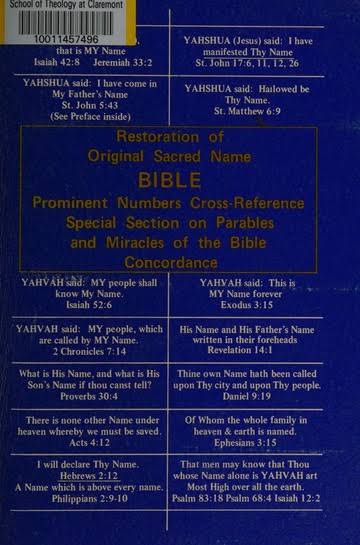
A later rebound or retitled copy supplied for this review bears the English title The Ancient Original Hebrew Sacred Name of Yahvah. The owner identifies this as the cover altered by Hannes Redelinghuys. The photograph can establish what is printed on that particular object; by itself it cannot establish who designed or manufactured the cover, so that attribution should be independently documented if it is used as a biographical accusation.
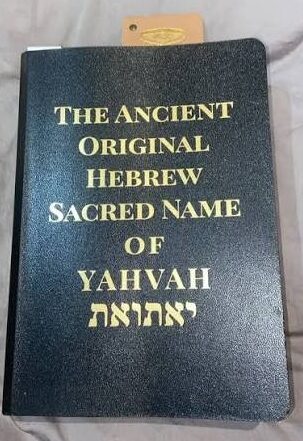
The Hebrew error is not cosmetic. The biblical Tetragrammaton is four consonants: יהוה, read from right to left. The cover’s gold inscription contains a different five-character sequence. Whatever was intended, it does not spell יהוה. That elementary mistake is especially damaging because the entire publication programme rests on claims of superior knowledge of the “original Hebrew” name.
What, if anything, does the edition achieve?
The edition correctly reminds readers that English “LORD” represents יהוה in most Old Testament translations, and that this convention can hide distinctions visible in Hebrew. That observation is legitimate. It does not validate “Yahvah,” “Yahshua” or “Yahvahshua,” and it does not justify placing unattested forms into the New Testament.
At the same time, its title promises more than its method can demonstrate. “Restoration” suggests the recovery of lost original wording. In the Hebrew Bible, replacing “LORD” with a form of YHWH does recover a distinction visible in the Hebrew consonants, although “Yahvah” remains a disputed vocalization. In the New Testament, the sacred-name replacements are conjectural and should be labelled as such. The forms “Yahshua” and especially “Yahvahshua” likewise require more caution than the edition’s rhetoric normally permits.
Final verdict
As a historical artefact of the Sacred Name movement: useful for research.
As a readable general-purpose English Bible: limited by dated language and specialist vocabulary.
As an independent scholarly translation: it is not one. The underlying English is overwhelmingly Rotherham’s, while its distinctive names lack adequate manuscript and linguistic support.
As proof of the original pronunciation of divine names: unreliable. “Yahvah” is not the academic consensus, and “Yahvahshua” is a constructed form rather than an attested historical name.
The ROSNB asks a legitimate question—what is lost when יהוה is represented by “LORD”?—but answers it through unsupported reconstruction. Its distinctive readings are not discoveries from ancient manuscripts. They are modern doctrinal substitutions placed into an existing translation, sometimes visibly so. No responsible academic work should cite “Yahvah” or “Yahvahshua” as though the ROSNB had recovered wording lost from the biblical text.
Sources and further reading
- The Restoration of Original Sacred Name Bible, Missionary Dispensary Bible Research, 1976, preface and text.
- J. B. Rotherham, The Emphasized Bible, complete edition, 1897.
- Gary Mink, “The Restoration of Original Sacred Name Bible”—a strongly critical Sacred Name movement review, useful for publication history and comparison but not treated here as neutral.
- Yahweh’s Restoration Ministry, Restoration Study Bible—included to distinguish the similarly named later publication.
- Emanuel Tov, Textual Criticism of the Hebrew Bible, for Hebrew textual transmission.
- Bruce M. Metzger and Bart D. Ehrman, The Text of the New Testament, for Greek manuscript transmission.


[…] The Restoration of Original Sacred Name Bible: A Critical Academic Review […]