
What a world of machines, manufactured reality and one reluctant hero can teach us about spiritual blindness, freedom and the cost of waking up.
Imagine discovering that the life you know is a carefully constructed illusion.
Your work, your routines, the things you chase and the things you fear—all taking place inside a system you have never thought to question. You feel free because you cannot see the boundaries.
Then someone offers you a way out.
There is only one problem: the truth will cost you the comfort of the life you understand.
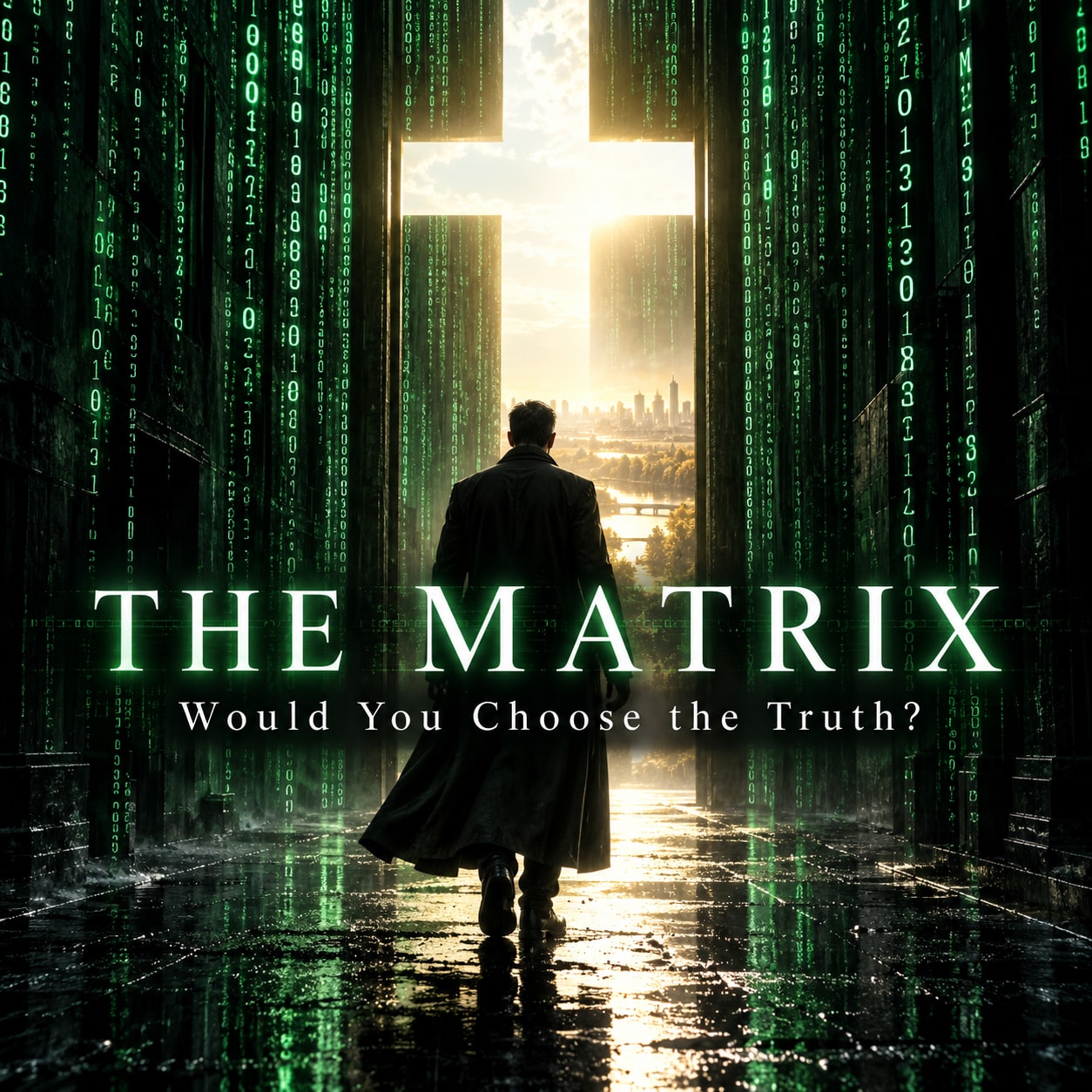
That is the unsettling invitation at the heart of The Matrix. Beneath the leather coats, flying bullets and green computer code lies a question that reaches far beyond science fiction:
Would we still want the truth if believing it made our lives harder?
For Christian viewers, that question opens a fascinating conversation about spiritual captivity, new birth, betrayal and salvation. The film offers several striking biblical echoes, though reading those echoes does not require treating it as a Christian sermon or every character as a coded biblical figure.
A prison you cannot see
The most disturbing thing about the Matrix is how ordinary it feels to the people inside it.
They go to work. They make plans. They worry about tomorrow. Their captivity continues because they mistake the world presented to them for the whole of reality.
As a spiritual metaphor, that lands uncomfortably close to home.
We can organise our lives around money, approval, pleasure or religious respectability without asking what those things are doing to us. A person can have plenty of choices and still be ruled by fear. We can become so accustomed to a destructive habit that we begin calling it our personality.
In John 8, Jesus connects truth and freedom, but he also identifies the captivity in question: slavery to sin. His promise concerns a freedom rooted in his word and ultimately in the Son himself. It is deeper than discovering information other people have missed. (John 8:31–36)
That distinction matters. Knowing that something is wrong does not necessarily give us the power to stop serving it.
Jesus says, “If the Son therefore shall make you free, ye shall be free indeed” (John 8:36, KJV). Read alongside his warning about slavery to sin in verse 34, this makes the point sharper: Christian freedom comes through the Son, rather than through the satisfaction of knowing more than our neighbours.
Sometimes the first crack in our illusion appears when we finally admit: “I keep calling this freedom, but it is controlling me.”
The red pill and the cost of waking up

The red pill offers Neo an encounter with reality. It does not offer him an easier life.
The choice itself is set out in the shooting script, PDF pages 30–31, scene 28. Its spiritual significance here is a comparison drawn from the scene, rather than a claim that taking a pill is equivalent to Christian conversion.
His awakening is frightening and physically humiliating. The familiar world disappears. He becomes painfully aware of his weakness and dependence on others.
That makes the scene a useful picture of how disruptive truth can be.
We often imagine spiritual growth as a reassuring experience in which God confirms what we already believe. Yet repentance can involve discovering that we have defended something false, hurt someone unjustly or built our confidence on the wrong foundation.
Jesus’ call to discipleship includes denying oneself, taking up one’s cross and following him (Mark 8:34–36). That gives the discussion its biblical weight: following Christ can cost us approval, security and cherished ambitions.
The imagery of Neo emerging from his pod and being rescued from the water can also invite a comparison with baptism and new birth. Christians may recognise the movement from an old existence into a new one.
In John 3:3–8, Jesus tells Nicodemus that entry into God’s kingdom requires new birth and describes the Spirit’s work. Paul connects baptism with burial into Christ’s death and walking in newness of life (Romans 6:3–4). These passages explain the comparison while keeping its centre on God’s action in Christ.
The comparison has limits. Christian new birth is God’s work, and baptism’s meaning cannot be reduced to becoming intellectually enlightened. Still, the scene gives us a powerful question to carry into our own lives:
What am I afraid of losing if I face the truth?
Neo and our longing for a deliverer
Neo’s story carries recognisable messianic themes: an expected deliverer, uncertainty about his identity, opposition, self-sacrifice, death and a return to life.
These features invite comparison with the gospel story. They also touch a very human longing—the hope that someone can enter our captivity and do what we cannot do for ourselves.
However, Neo’s story and Jesus’ story should not be collapsed into one another.
Within the film, Neo discovers an extraordinary relationship to the simulated world and its rules. The Christian gospel centres on Jesus’ saving death and resurrection, rather than humanity learning to manipulate reality through awakened consciousness.
Paul gives the gospel concrete content: Christ died for our sins, was buried and rose again on the third day (1 Corinthians 15:3–4). Jesus describes his own mission as service and giving his life as a ransom for many (Mark 10:45). The Christian claim concerns what Jesus has done to save us, not simply what we learn to see.
The parallel works best as a doorway into discussion.
Why do stories of deliverance move us? Why do we recognise the need for rescue so readily in fiction, while finding it difficult to admit our own need?
Neo gives those questions a dramatic shape. Christianity offers its own answer about who the deliverer is and what he delivers us from.
Morpheus and the faith that points beyond itself
Morpheus can be read as a forerunner figure, inviting comparison with John the Baptist.
He announces the coming deliverer, searches for him and places his hope in someone beyond himself. His confidence helps Neo begin a journey Neo does not yet understand.
For Christians, this raises a searching question about spiritual leadership.
Does a leader help people grow in truth and maturity, or make them increasingly dependent on the leader’s approval? Can people ask honest questions? Is loyalty to God quietly being replaced by loyalty to a personality?
The forerunner image is valuable because it reminds us that a spiritual guide should be able to point beyond himself.
John the Baptist expresses that attitude plainly: “He must increase, but I must decrease” (John 3:30, KJV). In John 1:29–34, he directs attention to Jesus as the Lamb of God. That is the biblical basis for the forerunner comparison—and a useful test of leadership that makes itself indispensable.
There is another necessary qualification: Morpheus’s certainty does not make certainty itself a virtue. Sincere conviction still needs examination. Confidence can encourage faith, but it can also protect an error when nobody is allowed to question it.
Cypher and the appeal of a comfortable lie

Cypher may be the film’s most uncomfortable mirror.
He has encountered reality and wants to go back. His betrayal is bound up with his desire for comfort, status and the pleasures of the simulated world. His meal with Agent Smith gives that desire an unforgettable image: a man enjoying an experience he knows is manufactured.
His resemblance to Judas lies in the betrayal of companions for a personal reward. Yet the scene reaches beyond a simple character comparison.
Matthew 26:14–16 records Judas agreeing to hand Jesus over for thirty pieces of silver. The parallel with Cypher concerns betrayal for a reward; the characters’ circumstances and motivations are not identical.
Cypher makes us confront the possibility that people sometimes reject truth because they understand its cost.
Hebrews 11:24–26 offers a revealing contrast: Moses chooses suffering with God’s people over the temporary pleasures of sin and Egypt’s riches. The passage helps us name the temptation in Cypher’s choice: preferring present comfort to costly faithfulness.
We may recognise that temptation when we avoid correcting a profitable falsehood, excuse wrongdoing to protect our position, or refuse to reconsider a belief because our entire social circle shares it.
It is easy to condemn Cypher from the sofa.
It is harder to ask what comfort we have made non-negotiable.
The screenplay places this tension between truth and comfort at the centre of his bargain. (The Matrix shooting script, PDF pages 61–62, scene A71)
Trinity and the love that calls Neo back
Trinity’s name naturally invites theological reflection. Her role in Neo’s return to life adds to the association: she speaks her love over him at the moment of apparent defeat.
A Christian reading can hear echoes of life, faithfulness and love overcoming death.
Scripture locates life-giving love in God’s sending of his Son: “that we might live through him” (1 John 4:9–10, KJV, excerpt from verse 9). This gives a Christian reader language for reflecting on love and life, without making Trinity the source of salvation described in that passage. The film scene can be checked against the shooting script, PDF pages 127–128, scenes 208–210.
But calling Trinity a direct representation of the Holy Spirit goes further than the story can securely establish. The proposed character mappings do not remain consistent enough to function as a neat diagram of Christian doctrine.
We can appreciate the scene without forcing that diagram.
Trinity remains present when hope appears exhausted. Her love gives the moment its emotional force. It invites reflection on the importance of being known and loved when failure, fear or death seems to have spoken the final word.
Where the comparison must stop
A responsible Christian reading must also notice where the film’s imagery pulls in a different direction.
Escaping an artificial world can suggest that salvation means escaping material existence itself. Christianity, however, begins with God declaring creation good. It also speaks of the Word becoming flesh and places bodily resurrection at the centre of its hope.
Those convictions have specific textual foundations: creation is described as very good in Genesis 1:31; the Word becomes flesh in John 1:14; and Paul describes the resurrection of the dead in 1 Corinthians 15:42–49. Romans 8:19–23 also speaks of creation’s liberation and the redemption of our bodies. Christian hope reaches beyond escape to redemption.
The Christian problem is therefore not simply that we have bodies or inhabit a physical world. Sin corrupts our relationship with God, one another and creation. Christian hope concerns redemption, rather than merely abandoning embodied life.
That difference helps us enjoy the film thoughtfully. A compelling metaphor can illuminate part of the gospel without explaining all of it.
It also guards against turning every name, room number and camera angle into a secret theological message. The strongest connections are already substantial enough: captivity, awakening, betrayal, deliverance and the cost of truth.
The question we bring home
Perhaps the most useful question after watching The Matrix is not whether we can identify every hidden reference.
It is whether we are willing to examine the things we have stopped questioning.
That includes our culture, our habits and our religious communities. It also includes our own cherished claim to be more awake than everyone else. Believing we see through other people’s illusions can become a comfortable illusion of its own.
For a Christian, the response is humility: a willingness to be corrected, to repent and to follow Christ when obedience becomes inconvenient.
Paul’s instruction is brief: “Prove all things; hold fast that which is good” (1 Thessalonians 5:21, KJV). In its immediate context, this includes testing prophetic claims rather than either despising or accepting them uncritically. The same disciplined attitude can guide our engagement with a film: examine what it suggests, receive what is sound and recognise where the comparison ends.
The film leaves us with an arresting image of awakening. The gospel presses the question into daily life.
When truth asks something of us, will we still want it?
Sources and further reading
The film and its screenplay
Contextual summary: The Wachowskis’ The Matrix (1999) is the film discussed here. The shooting script provides primary-source context for the red-pill choice, Cypher’s bargain and the climax involving Neo and Trinity. A shooting draft may differ from the released film. The biblical character comparisons in this article are interpretations, rather than quotations of a statement of intent by the filmmakers. Read the numbered shooting script, dated March 29, 1998.
Scene locators: The red-pill offer is in scene 28, PDF pages 30–31; Cypher’s restaurant bargain is in scene A71, PDF pages 61–62; Trinity’s declaration and Neo’s return to life appear in scenes 208–210, PDF pages 127–128. PDF page numbers count the title page and can differ from the printed screenplay pagination.
Truth, new birth and the forerunner
Contextual summaries: John 8:31–36 connects remaining in Jesus’ word, truth and freedom from slavery to sin; the Son is the one who sets people free. John 3:3–8 describes birth through the Spirit, while Romans 6:3–4 connects baptism with Christ’s death and new life. John 1:19–34 and John 3:28–30 present John the Baptist as a witness who points beyond himself to Jesus. These passages ground the theological discussion; none identifies a film character as its fulfilment.
Discipleship, betrayal and discernment — contextual summaries: Mark 8:34–36 connects following Jesus with self-denial and the cost of discipleship. Matthew 26:14–16 documents Judas’s bargain. Hebrews 11:24–26 contrasts Moses’ faithfulness with temporary pleasure and wealth. 1 Thessalonians 5:19–22 places testing claims alongside openness to the Spirit and rejection of evil.
Creation, incarnation and resurrection
Contextual summaries: Genesis 1:31 describes God’s creation as very good. John 1:14 speaks of the Word becoming flesh. 1 Corinthians 15:3–4, 20–23, 42–49 links the gospel to Christ’s death and resurrection and describes the resurrection of the dead. These texts explain why Christian salvation should not be reduced to escape from physical existence.
Love and redemption — contextual summaries: 1 John 4:9–10 explains God’s love through the sending of the Son so that we might live through him; verse 10 connects that love with his dealing with our sins. Romans 8:19–23 describes creation’s hope of liberation and believers’ expectation of bodily redemption. Direct Scripture quotations added within this article use the King James Version (KJV); links identify the translation used.



[…] Continue the discussion: The Matrix and the Gospel: Would You Choose the Truth? […]