

The Old Apostolic Church belongs to a wider movement whose modern history includes revival meetings, disputed apostolic callings and several distinct church divisions. The family relationships matter, but the dates need careful labels. A revival, an organisational separation, a legal settlement and a later change of name can all concern the same community without being the same event.
This overview separates those milestones and identifies the evidence behind them. The strongest item for the South African naming dispute is the surviving 1926 settlement document. The other histories below are published by the churches themselves: useful accounts of how they understand their origins, which should still be read critically.
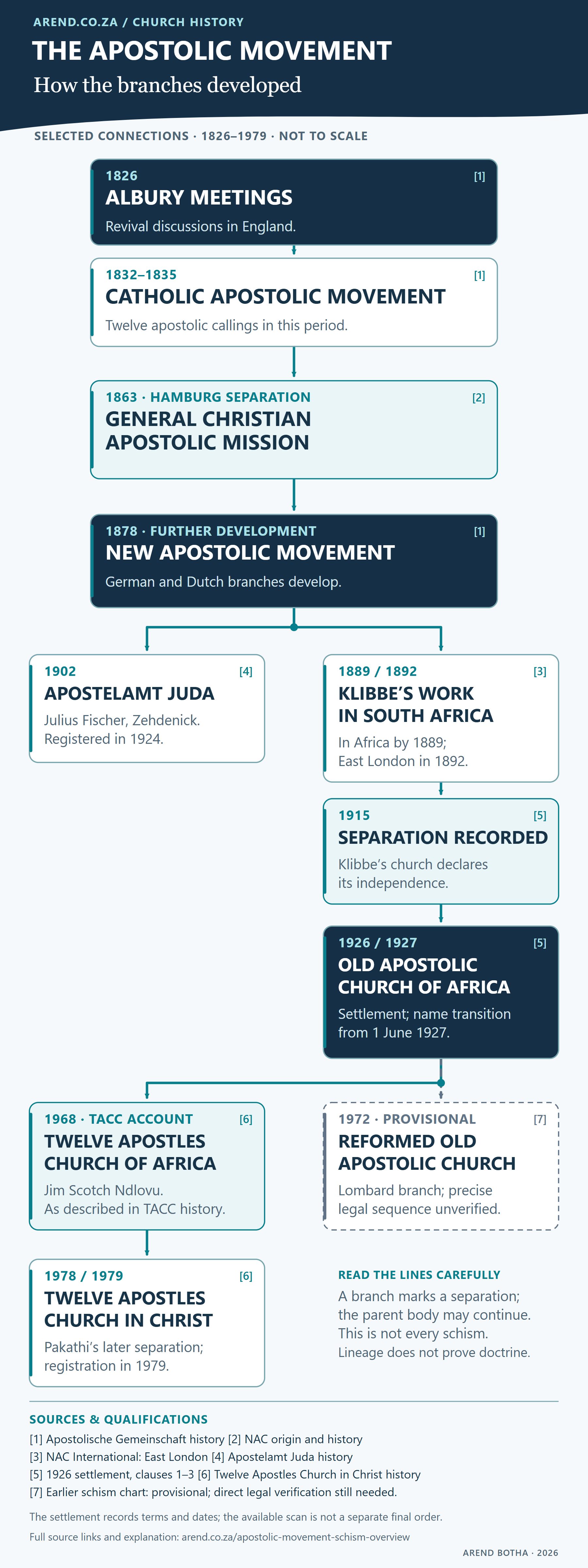
A chart is a guide, not a verdict
An arrow on a family tree means that a historical connection is being proposed. It cannot prove that a leader was appointed by God, that a later church preserved every earlier doctrine, or that a separation was morally justified. Those are separate questions. Equally, a schism does not by itself disprove a community’s beliefs. A movement may divide over leadership, interpretation, administration or several issues together.
The original visual concept discussed here came from the critical blog History — The schism tree. Its diagram prompted the investigation, but it is not the authority for the chronology. The outline below corrects the oversimplified New Apostolic naming sequence and keeps the later South African branches distinct.
From the Albury meetings to the Catholic Apostolic movement
The Apostolische Gemeinschaft’s historical account begins with the nineteenth-century search for spiritual renewal. It describes Henry Drummond gathering clergy and laypeople at Albury in 1826 to discuss prophetic promises and expectations of Christ’s return. In that account, connections with Scotland brought reports of prophecy, tongues and healing into the picture.
The movement developed its own congregations and ministry. Twelve apostles were called between 1832 and 1835, according to that institutional history. The word Catholic in Catholic Apostolic belongs to this movement’s name; a reader should not silently substitute Roman Catholic and draw a different family tree. Nor does using apostolic establish an uninterrupted institutional chain back to the first-century apostles.
1863 and 1878 describe different developments
The New Apostolic Church’s own history identifies the 1863 Hamburg schism as the starting point of its development. It associates the disagreement with biblical interpretation and the calling of further apostles. The body that emerged was known as the General Christian Apostolic Mission. This connects the later movement to a particular nineteenth-century dispute rather than to an undefined ancient institution.
The Apostolische Gemeinschaft’s chronology then places a further development in 1878: the emergence of communities including the Neuapostolische Gemeinde in Germany. These accounts describe stages, not one simple renaming. A chart which puts “New Apostolic” beside 1873 without explaining its source can collapse separation, development and later terminology into a misleading single date. The broader label “New Apostolic movement” is more useful where that precision is missing.
Klibbe’s work in South Africa
The New Apostolic Church International records Carl Klibbe’s missionary work in its account of East London. It explicitly says that his exact arrival date in Cape Town is unknown, while a letter dated 21 October 1889 places him in Africa by then. Its narrative describes work in Cape Town and Worcester, followed by a congregation near East London in 1892.
This is a firmer way to write the opening chapter than assigning a precise arrival day without a record. It also reminds us that the early South African congregations and the later institutions grew through a sequence of events. Sending a missionary, establishing a congregation and separating from an overseas administration need their own evidence.
What the 1926 settlement changes in this timeline
The surviving terms of settlement in Case 432 of 1926 give a more precise basis for the naming history. Clause 1 records that Klibbe’s church had severed its connection and declared independence in 1915. Clause 2 recognises that independence. Clause 3 sets out the undertaking to stop using the New Apostolic name from 1 June 1927, while allowing a clearly distinguishable name, including “The Old Apostolic Church of Africa”. The terms themselves are dated 16 December 1926.
These dates answer different questions. The document records an earlier separation, sets out a settlement and provides for a later naming transition. It should not be reduced to “a court founded the church in 1926”. Neither the word Old nor recognition of a leader’s title proves divine authority. The available copy also does not independently establish that every condition was fulfilled or include a separate final order. Read the full plain-language guide to the court case for the clauses and their limits.
Other branches of the apostolic family
The South African OAC line is one part of a wider family. The following branches developed at different times and should not be treated as interchangeable names for the same church.
The Reformed Old Apostolic Church came from a later OAC division under Robert William Lombard. The separation took place in 1972; the Reformed Old Apostolic name was adopted in 1975. These are different dates for different stages of its history.[20]
The related church history cited here supports those two dates. It is an institutional historical account, and does not independently establish the detailed legal sequence.
The United Apostolic churches include churches that separated from the NAC in the 1950s. The South African body belongs to this history. The wider United Apostolic Community consists of legally and financially independent churches; it is not simply one worldwide denomination with a single central government.[19]
The Dutch Apostolic Society, or Apostolisch Genootschap, belongs to another branch of this history. It grew out of the Dutch apostolic communities and the succession dispute following Van Oosbree’s death in 1946, and was formally established in 1951. It should not be confused with the OAC.[23]
The NAC is the largest church in this family. Its official statistical sheet records 9,508,089 members worldwide at 31 December 2025, or about 9.5 million. That dated official figure is more useful here than repeating the much older 16-million estimate found in some summaries.[18]
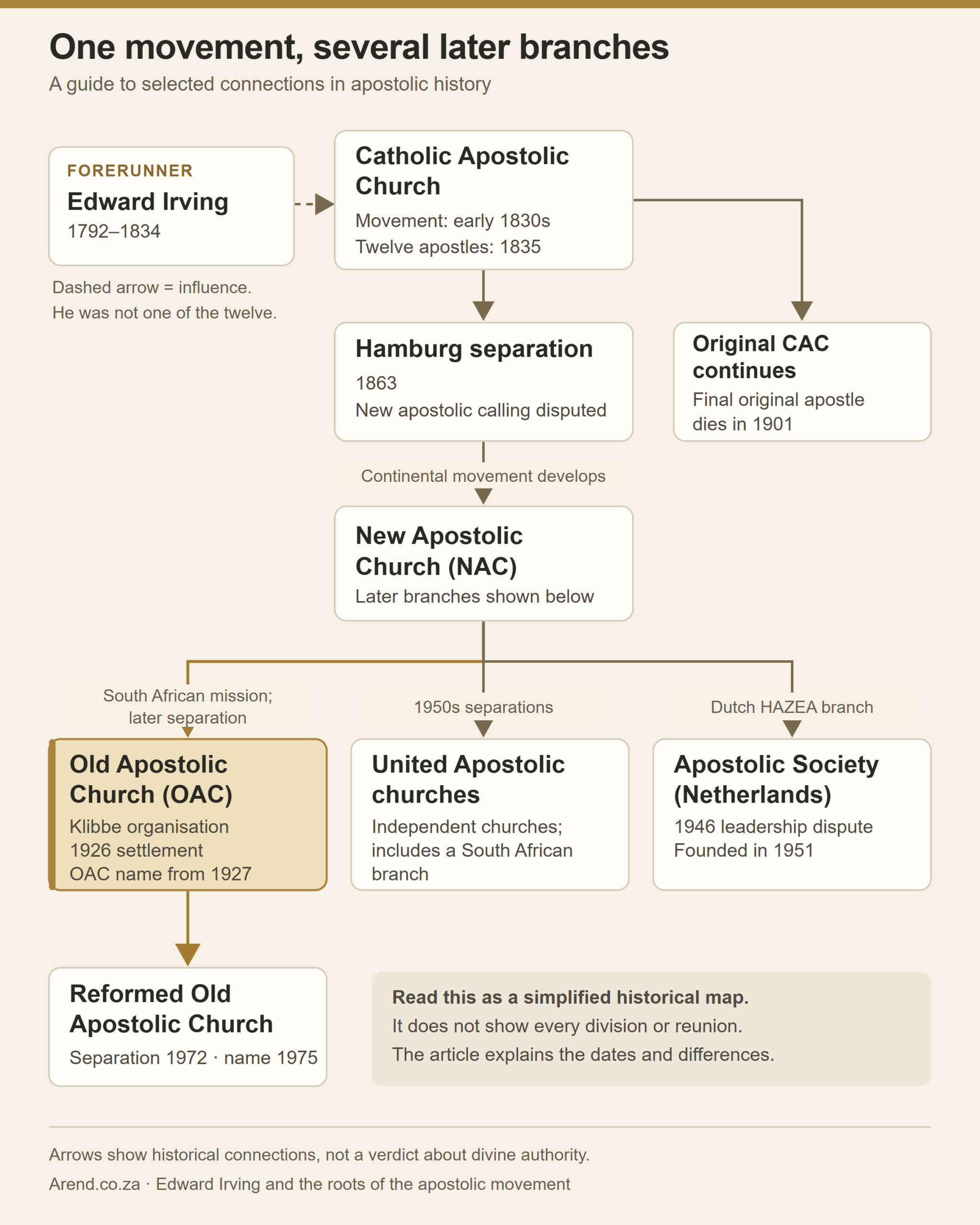
This second diagram selects the branches just discussed. The earlier vertical chart also includes Apostelamt Juda and the distinct Twelve Apostles branches, which are explained below. Neither diagram attempts to show every separation.
Apostelamt Juda needs its own branch
Apostelamt Juda should not be placed as a descendant of the wrong 1878 community simply because a line fits neatly on a graphic. Its published institutional account names Julius Fischer and dates its foundation in Zehdenick to 2 May 1902. It separately records registration in January 1924. These are the community’s own historical claims, with the founding event and legal registration kept distinct.
The account also describes the revelation associated with Fischer’s role. Reporting that a group traces its origin to a prophecy is a historical description of its claim. Confirming the prophecy’s divine source would require a different argument. A useful family tree should preserve that distinction rather than turning a claimed calling into an established theological fact.
The Twelve Apostles names must not be mixed up
The website used here belongs to the Twelve Apostles Church in Christ, not the Twelve Apostles Church of Africa. Its history page retrospectively connects Jim Scotch Ndlovu with the formation of the Twelve Apostles Church of Africa in 1968. It then describes the Church in Christ’s later separation under Pakathi in 1978, followed by registration in 1979. The similar names make an explicit distinction necessary.
That testimony is useful for understanding the institution’s account of its roots. It is not a substitute for contemporary correspondence, incorporation records or court papers. Its wider narrative includes claims which need checking in their own right; citing the page for a limited point does not endorse every statement on it. For the separate Lombard branch, a related church’s institutional history supports the 1972 separation and adoption of the Reformed Old Apostolic name in 1975; its detailed legal sequence has not been independently verified here.[20]
A compact chronology
- 1826: Albury meetings in the Apostolische Gemeinschaft’s account of the revival movement.
- 1832–1835: apostolic callings within the emerging Catholic Apostolic movement.
- 1863: Hamburg separation and the General Christian Apostolic Mission.
- 1878: a later development in the German and Dutch branches; distinguish it from a simple 1873 name change.
- 1889 and 1892: evidence for Klibbe in Africa, then the East London congregation in the New Apostolic account.
- 1902: Apostelamt Juda’s stated foundation under Julius Fischer; registration is recorded separately in 1924.
- 1915 / 1926 / 1927: separation recorded in the settlement, date of its terms, and effective naming transition.
- 1968 / 1978 / 1979: the distinct Twelve Apostles milestones described in the Church in Christ’s retrospective history.
- 1972 / 1975: the Lombard separation and later Reformed Old Apostolic name, supported by a related church’s institutional history; the detailed legal sequence remains independently unverified.[20]
What this history can help us test
Read each arrow with three questions: which people or congregations moved, what document establishes the connection, and what exactly does its date describe? Two websites repeating the same account are not necessarily independent witnesses. A modern church history is evidence of that church’s account; a dated settlement is evidence of what the parties recorded and agreed. Neither source should be asked to answer questions beyond its scope.
Theological assessment needs the actual teaching. 1 John 4:1 calls believers to test claimed spiritual teaching, and the next verses focus on the confession of Jesus Christ come in the flesh. The challenge for a modern claim to apostolic authority is therefore more substantial than drawing the longest line: what is being taught about Christ, salvation and the gospel, and how does it fit the apostolic witness? Historical research clarifies the claim before that assessment begins.
The original article also pointed to Galatians 1:6–9 on preserving the received gospel, and 1 Corinthians 1:10–13 on factional loyalties. These passages keep historical comparison from becoming a contest over names while leaving room for careful examination of the doctrines actually claimed.
Conclusion
The apostolic movement has a traceable modern history, with several branches and different kinds of milestone. Careful dates and properly identified sources make that history clearer. They also leave the central question open for the right evidence: institutional descent explains a community’s origin; its teaching must still be examined on its own terms.
Sources for the additional branches
These sources support the additional branches and the dated membership figure above. They are church publications; the 1972 and 1975 dates are distinguished from an independently verified legal sequence.
- New Apostolic Church International, NAC worldwide: the key figures, with the linked Facts Figures Data 2025 sheet: 9,508,089 members at 31 December 2025. Checked 30 October 2026. Open source 18 ↗
- Peter Johanning, ‘Meeting with delegation from the United Apostolic Church’, nac.today, 16 March 2016. Official NAC account of the South African body and the wider family of independent United Apostolic churches. Open source 19 ↗
- Apostolische Gemeinschaft, Unser Weg, historical instalment 11, sections on South Africa. A related church’s institutional historical account; used for the 1972 separation and 1975 Reformed Old Apostolic name, without treating its theological judgments as neutral proof. Open source 20 ↗
- Apostolisch Genootschap, Historie, official account. Read with its Den Haag historical outline for the HAZEA branch; the simplified diagram does not attempt to reproduce every Dutch separation. Open source 23 ↗
Read the connected studies
- Edward Irving: his life, ministry and the controversy about Christ’s humanity
- The Catholic Apostolic Church: its ministry, worship and sealing
- Christ’s return: comparing Irving, the OAC and the NAC
Sources and further reading
Institutional histories
- New Apostolic Church: Origin and History. Relevant paragraphs: revival movement and 1863 Hamburg schism.
- Apostolische Gemeinschaft: Geschichte. Relevant sections: 1826, 1863 and 1878. German original.
- New Apostolic Church International: East London, the first congregation in Africa, 8 July 2014.
- Apostelamt Juda: institutional history. Distinguish the 1902 foundation claim from the 1924 registration.
- Twelve Apostles Church in Christ: History. A retrospective institutional account; the 1968, 1978 and 1979 references concern different events.
Settlement document and biblical assessment
Court Case 432 of 1926: eight-page settlement scan. Clauses 1–3 and page 8 establish the milestones discussed above. The scan is settlement terms, not a separate final order.
Galatians 1:6–9 (KJV) provides the theological test; it does not supply the historical chronology.
Original chart and verification limits
The earlier chart discussion and its source remain available at History — The schism tree. Its 1972 branch is now supported for the separation and 1975 naming dates by the related institutional history cited above; the detailed legal sequence is not presented as independently verified here. The chronology above keeps the distinctions visible in text.
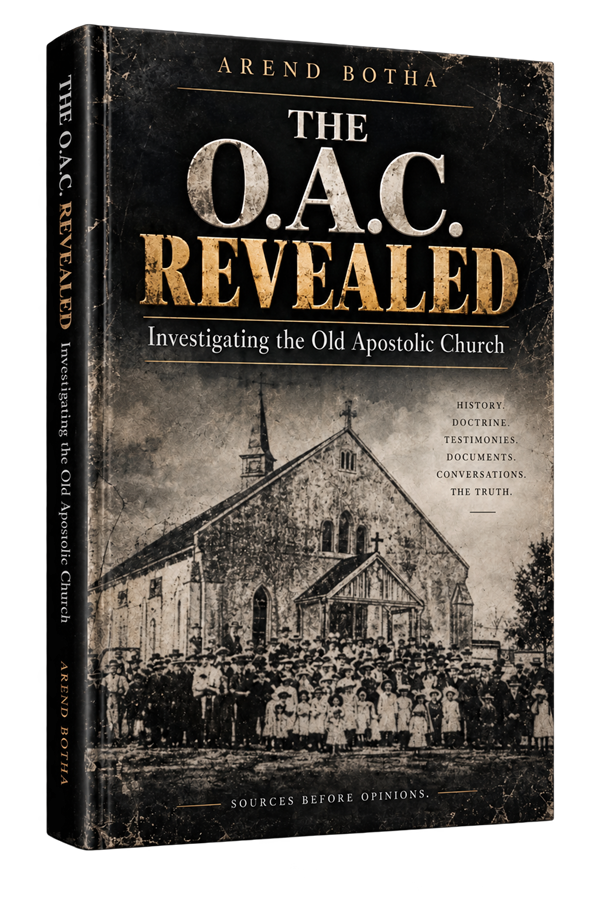
THE OAC REVEALED
By Arend Botha. An investigation of the church’s history, doctrine and lived experience, with primary sources and clear distinctions between official teaching, personal testimony and assessment.
Categories: Irvingism · Catholic Apostolic Church · New Apostolic Church · Old Apostolic Church



You dont knows hostories of the chucrj .. i do.. ask me.
“You dont know” is not a refutation. Please provide facts, I would be happy to investigate.
If you take a look at later historical events, since 1995, you will see that many of the so-called schisms reunited with the Old Apostolic Church. Four Apostles of the German Apostelampt Jesu Christi (Apostelampt Juda) united with the OAC. Of these four Apostles, U Jacob and HG Richter is the Apostles responsible for Europe and the United Kingdom and Ireland (Apostle Stohwasser passsed away and Apostle Schulz retired due to health issues). There also has been a large movement of former members of other groups joining the OAC.
The so-called South African schism was due to the German Apostle Niehaus who introduced strange theology that he described in full in his book “Oude en Nieuwe Wege”. It is due to this that some German, Dutch and Australian groups broke from the German branch under Niehaus.
In my own experience I have seen good cooperation between the various Apostolic Churches that broke with the NAC. Even going as far as international visits by Apostles and Fourfold Officers.
I would like to point out a schism currently going on in South Africa in the Dutch Reformed Church between what is termed as “Behoudend” (Dolerend) and “Nie-behouddend”. There is also a paragraph in the book by the late Pastor Andre Pelser on how various Charismatic churches openly “steal” members from each other and “low-level warfare” among them. First look at yourself before critisizing others.
Melt, later reunifications add to the timeline; they do not erase earlier splits. Your explanation involving Niehaus acknowledges a schism and proposes its cause—it does not refute its existence. The article explicitly states that **a schism does not, by itself, disprove a church.**
Friendly visits between apostles and disputes among Dutch Reformed or Charismatic churches do not contradict the historical relationships described. I’m not defending those denominations here. **Historical claims are tested against evidence, not the critic’s presumed church membership.**