

Babylon Mystery Religion by Ralph Woodrow: The Book Its Own Author Withdrew
Some controversial books are dismantled by historians. Others are exposed by critics. Babylon Mystery Religion, however, has a far more interesting story:
Its own author eventually withdrew it.
Ralph Woodrow first published Babylon Mystery Religion: Ancient and Modern in 1966. The book presented itself as a biblical and historical investigation into how the religion of ancient Babylon supposedly survived through the centuries and eventually became mixed with Christianity—especially within the Roman Catholic Church. The 1981 edition announced that more than 175,000 copies were already in print, while Woodrow later explained that the book had gone through numerous printings and had been translated into several languages. (dn790002.ca.archive.org)
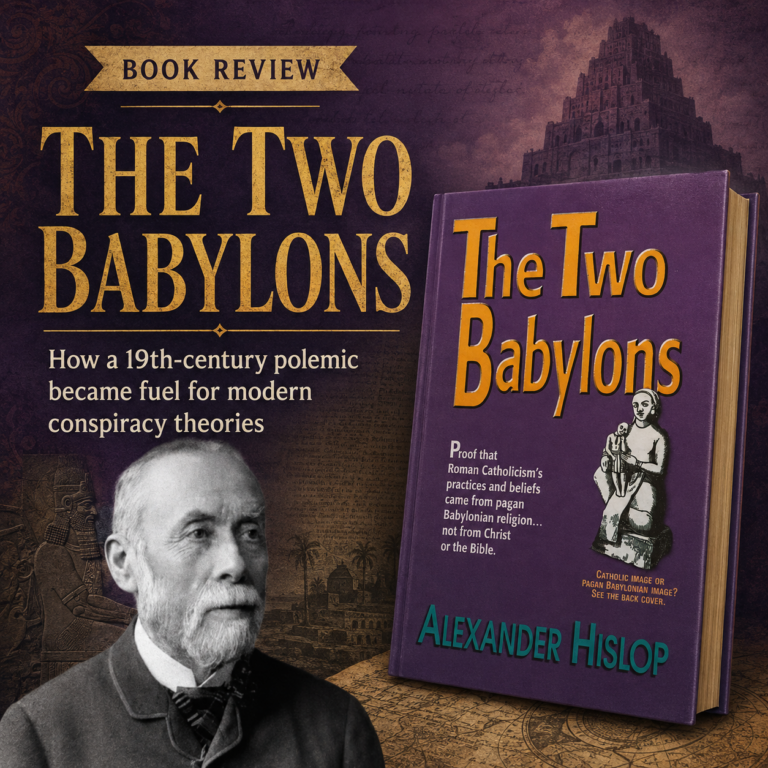
For many Christians, it became the easier, more accessible version of Alexander Hislop’s The Two Babylons.
There was only one major problem.
Woodrow eventually discovered that much of the historical foundation upon which his book had been built was unreliable.
What does the book argue?
Babylon Mystery Religion begins with the theory that Babylon was the original source of organised false religion. According to the book, Nimrod established a rebellious religious system, while his supposed wife Semiramis and her child Tammuz became the original model behind the mother-and-child worship found in later civilisations.
From there, Woodrow attempts to trace a vast network of religious practices back to Babylon.
The book discusses:
- devotion to Mary and the saints;
- statues, images and religious symbols;
- obelisks, temples and church towers;
- the use of the cross;
- Constantine’s conversion;
- relics and pilgrimages;
- purgatory and indulgences;
- the office of the pope;
- religious clothing and titles;
- Christmas, Easter and Lent.
Its basic argument is simple: many Roman Catholic beliefs and customs resemble practices found in pagan religions; therefore, those beliefs and customs must have originated in Babylonian paganism. The book’s contents explicitly present Nimrod, Semiramis and Tammuz as the starting point from which pagan religion spread through the Roman world and entered Christianity. (dn790002.ca.archive.org)
It is an impressive theory.
It is also far more difficult to prove than the book allows its readers to believe.
Why the book became so influential
Woodrow was not merely copying Hislop word for word. He took Hislop’s dense, nineteenth-century argument and repackaged it for ordinary Christian readers.
The language was easier. The chapters were shorter. The illustrations were memorable. The conclusions were clearly stated.
Woodrow later acknowledged that many readers preferred his book because it was easier to understand than The Two Babylons. It became so closely associated with Hislop’s theory that Woodrow was once mistakenly introduced as “Reverend Hislop.” (equip.org)
That accessibility became the book’s greatest strength—and its greatest danger.
An uncertain historical theory was transformed into something that felt simple and obvious:
Babylon created pagan religion. Pagan religion entered Rome. Rome mixed it with Christianity. Therefore, Roman Catholicism is Babylonian religion wearing Christian clothing.
Once that framework has been accepted, almost every similarity becomes another piece of “evidence.”
A mother holding a child becomes Semiramis and Tammuz.
A religious tower becomes the Tower of Babel.
A saint becomes a renamed pagan god.
A feast becomes a disguised pagan festival.
A symbol becomes proof of secret religious continuity.
The theory feels powerful because everything can be made to fit inside it.
The fatal weakness inherited from Hislop
Woodrow’s central historical source was Alexander Hislop’s The Two Babylons. As a young evangelist, Woodrow had assumed that Hislop’s many footnotes and references demonstrated that the book was historically reliable.
Years later, he began hearing from teachers and researchers who questioned Hislop’s accuracy. Woodrow therefore returned to the sources and examined the argument more carefully. What he found changed his position completely. (equip.org)
He concluded that Hislop’s history was frequently an arbitrary combination of unrelated myths.
The most important example is the alleged family of Nimrod, Semiramis and Tammuz.
Hislop’s entire system requires the reader to accept that:
- Nimrod founded the original Babylonian mystery religion.
- Semiramis was his wife.
- Tammuz was their child.
- Their mother-and-child religion spread throughout the ancient world.
- Later goddesses and divine children were simply different versions of this original family.
But when Woodrow checked recognised historical reference works, he could find no support for the claim that Nimrod and Semiramis were husband and wife. He also found no historical basis for identifying Semiramis as the mother of Tammuz. Woodrow noted that the figures were not even placed in the same century by the sources he consulted. (equip.org)
That is not a small mistake hidden somewhere in the book.
It is the foundation of the entire theory.
When the foundation is historically unsound, the hundreds of later connections built upon it cannot carry the weight placed on them.
Similarity is not proof of origin
The main methodological problem in Babylon Mystery Religion is the assumption that similarity proves historical dependence.
Two religions may both use water, candles, incense, special clothing, sacred meals or religious images. That does not automatically mean one borrowed the practice from the other.
Human beings across different societies use similar objects and symbols because they live in the same world.
Water naturally represents washing.
Light naturally represents truth, life or knowledge.
Darkness naturally represents danger or ignorance.
A crown represents authority.
A mother holding a child represents motherhood.
A tower represents height, strength or access to the heavens.
Before claiming that one religion copied another, a historian must establish an actual line of transmission. We need evidence showing when the borrowing occurred, who transmitted it, how the meaning changed and whether the supposed source existed before the later practice.
Woodrow’s earlier book repeatedly moves directly from resemblance to conclusion.
That method can be turned against Christianity itself.
Woodrow later pointed out that pagans also prayed, practised ritual washing, regarded certain writings as sacred, knelt during worship and raised their hands. The Old Testament contains mountains, temples, pillars, sacrifices, sacred objects, holy places, first fruits and religious festivals. The existence of vaguely similar pagan practices does not make the Bible pagan. (equip.org)
A parallel may be interesting.
It is not automatically proof.
Partial information creates convincing errors
Another serious weakness is the selective use of sources.
A quotation may be genuine while the conclusion drawn from it is false. A writer can quote only the portion that appears to support his argument while leaving out information that changes its meaning.
Woodrow later examined Hislop’s claim that the Egyptians observed a forty-day fast corresponding to Lent. The source Hislop cited actually described Egyptian fasts lasting anywhere from seven to forty-two days—and sometimes longer. Choosing the number forty created the appearance of a direct connection that the complete source did not establish. (equip.org)
This illustrates the danger of impressive-looking references.
A footnote proves only that a source has been cited. It does not prove that the source has been represented accurately.
Most ordinary readers do not have access to all the old volumes being quoted. They see a page filled with names, dates and references and understandably assume that someone has already verified the argument.
That is how unreliable claims gain authority.
This is not a defence of every Catholic doctrine
Rejecting Babylon Mystery Religion does not require Protestants to abandon their criticisms of Roman Catholic teaching.
Questions concerning the papacy, Marian dogmas, prayer to saints, purgatory, indulgences, relics and the nature of the Mass can be examined directly from Scripture, early Christian writings and documented church history.
Woodrow himself did not conclude that every criticism of Roman Catholicism in his original book was false. He said the book still contained some valid information. His problem was that the valid material had been mixed with historical misinformation about supposed Babylonian origins. (equip.org)
That distinction matters.
A doctrine does not become biblical merely because someone constructed a bad argument against it.
But neither should Christians use false history simply because it appears to support a Protestant conclusion.
Truth does not need fabricated evidence.
A weak argument ultimately damages the position it was supposed to defend.
Woodrow’s intellectual honesty
This is where Ralph Woodrow deserves considerable respect.
Babylon Mystery Religion was not an obscure pamphlet that nobody had noticed. It was one of the most popular books associated with his ministry. It had been printed repeatedly, translated and quoted by readers who regarded him as an authority on pagan influence within Christianity. (equip.org)
Withdrawing it therefore carried a real cost.
Woodrow later stated clearly that he had not withdrawn the book because he was threatened, persecuted or pressured into compromising his beliefs. He withdrew it because he no longer believed he could publish it in good conscience.
His explanation was striking: he could not continue publishing a book opposing religious mixture when the book itself contained a mixture of truth and misinformation. (equip.org)
In 1997 he published The Babylon Connection?, a new book challenging many of the historical connections promoted in his earlier work. (Internet Archive)
That is what intellectual honesty looks like.
Woodrow did not merely change the cover, quietly remove a few paragraphs and continue selling the same theory. He publicly acknowledged the problem and replaced the book with one that corrected his earlier position.
Christian teachers should not be judged solely by whether they have ever made a mistake. Everyone who teaches publicly will eventually discover that something they said was incomplete, inaccurate or poorly argued.
The more important question is what they do when the mistake becomes clear.
Do they correct it?
Or do they protect their reputation by attacking everyone who notices?
The strange afterlife of a withdrawn book
Despite being withdrawn by its author, Babylon Mystery Religion continues to circulate online.
Scanned copies are shared. Old editions are sold. Screenshots are reposted. Its illustrations appear in videos and social-media posts without any mention that Woodrow later rejected the book’s central historical method.
This creates a bizarre situation: people continue using Woodrow as an authority for claims that Woodrow himself no longer defended.
Some conspiracy teachers may simply be unaware of his correction. Others appear uninterested in mentioning it because the correction weakens their content.
The original story is far more dramatic than the truth.
“The Church is secretly Babylon” attracts attention.
“The evidence is complicated, and many of the alleged connections cannot be established” does not perform nearly as well in a thirty-second video.
Conspiracy culture rewards confidence, not caution.
It rewards sensational connections, not careful distinctions.
It rewards people who claim to possess forbidden knowledge, even when that “knowledge” comes from a book withdrawn by its own author.
The real lesson of Babylon Mystery Religion
The most valuable lesson contained in this book is not the one Woodrow originally intended.
It is the story of what happened afterwards.
Woodrow began with a theory that appeared biblical, heavily documented and spiritually urgent. He preached it, wrote about it and became recognised as an authority on it.
Then he checked more carefully.
When the evidence failed, he changed his position.
That is not weakness. It is integrity.
Christians often speak about defending truth, but defending truth sometimes requires us to surrender an argument we once loved. It may require us to admit that a dramatic claim was built upon poor sources. It may require us to disappoint an audience that preferred the sensational version.
Our loyalty must be to truth—not to our favourite theory, denomination, teacher, video or book.
Is the book worth reading?
Yes—but mainly as a historical case study.
It is valuable for understanding how The Two Babylons entered popular evangelical culture and how complicated historical claims were repackaged for a wide Christian audience.
It also provides an excellent example of how conspiracy-style reasoning works:
- begin with a predetermined conclusion;
- collect similarities from different cultures;
- minimise the differences;
- assume borrowing without proving transmission;
- quote sources selectively;
- present speculation as historical certainty.
It should not, however, be treated as a reliable guide to Babylonian religion or the origins of Christian practices.
Anyone reading it should also read Woodrow’s later correction and examine the original sources behind its claims.
Reading the first book without acknowledging the author’s retraction tells only half the story.
Final verdict
Readability: 4/5
Historical reliability: 1.5/5
Influence: 4/5
Intellectual value as a case study: 4/5
Overall rating: 2/5
Babylon Mystery Religion is easier to read than The Two Babylons, but it inherits the same fundamental problems. It combines legitimate theological concerns with doubtful history, unsupported connections and a method that repeatedly treats resemblance as proof.
Yet the final chapter of this book’s history is unexpectedly encouraging.
Ralph Woodrow investigated his own claims, admitted that the evidence did not support them and removed a successful book from publication.
The tragedy is that conspiracy theorists continue promoting the book.
The triumph is that its author chose truth over popularity.
A book withdrawn by its own author should not continue functioning as unquestioned evidence for people who claim to care about truth.