
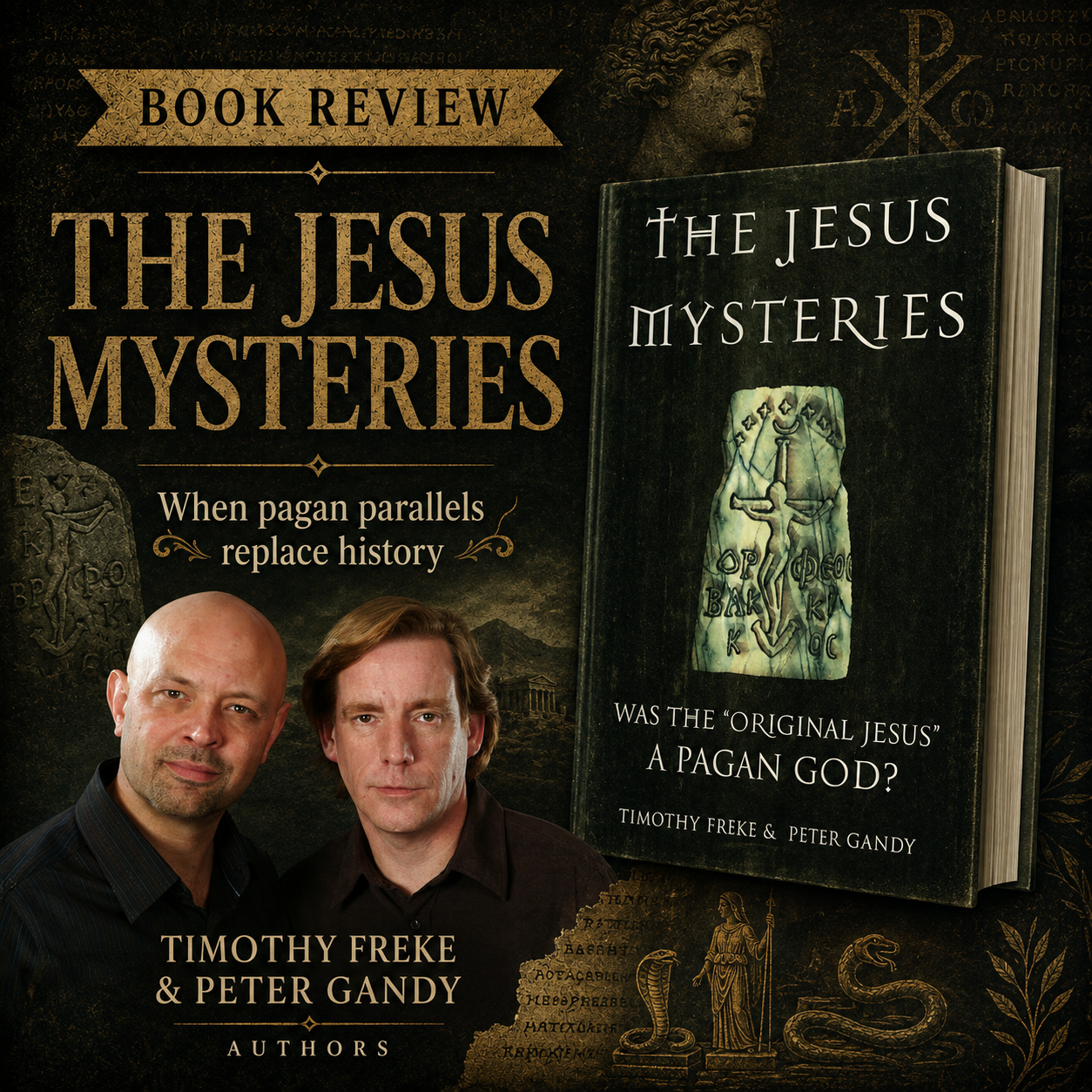
The Jesus Mysteries by Timothy Freke and Peter Gandy: When Pagan Parallels Replace History
Few claims spread through online conspiracy culture as quickly as this one:
“Jesus was copied from pagan gods.”
Horus was supposedly born of a virgin. Mithras allegedly had twelve disciples. Dionysus supposedly turned water into wine. Osiris died and rose again. Christianity, we are told, simply collected these older stories, changed the central character’s name to Jesus and concealed the evidence.
One of the most influential modern books behind this argument is Timothy Freke and Peter Gandy’s The Jesus Mysteries: Was the ‘Original Jesus’ a Pagan God?
Published in 1999, the book presents a dramatic reconstruction of Christian origins. Freke and Gandy argue that Jesus was not originally understood as a historical person. Instead, they claim that Jewish Gnostics created an allegorical saviour based upon the pagan mystery religions and a supposed composite god they call “Osiris-Dionysus.” According to their theory, later “Literalist” Christians misunderstood—or deliberately suppressed—this spiritual allegory and transformed the mythical Jesus into a man who supposedly lived in first-century Judea. (Westar Institute)
It is a fascinating theory.
It is also built upon selective parallels, questionable chronology and an imagined version of early Christianity that the available evidence does not establish.
What does the book argue?
Freke and Gandy believe that the original Christians were not followers of a historical Jewish teacher from Galilee. They were allegedly Jewish practitioners of a mystery religion who understood the Jesus story symbolically.
In their reconstruction, the Gospel story was modelled upon older myths involving dying and rising gods. Jesus therefore became the Jewish version of a universal pagan “godman” whom the authors call Osiris-Dionysus.
The basic argument works like this:
- Ancient Mediterranean religions contained stories about divine or semi-divine figures.
- Some of these stories contain themes that resemble elements of the Gospel narratives.
- Christianity emerged within the Greco-Roman world.
- Therefore, the Gospel writers constructed Jesus from the mystery religions.
- The historical Jesus was later invented by Christians who interpreted the allegory literally.
This is not merely the claim that early Christians communicated within a Greco-Roman culture or occasionally used familiar philosophical language. That would be historically uncontroversial.
The book claims something far more radical: Christianity began without a historical Jesus.
Why the book feels so convincing
Like The Two Babylons, The Jesus Mysteries overwhelms the reader with similarities.
The authors move between Egyptian, Greek, Roman, Jewish and Christian material, gathering stories, images, rituals, sayings and symbols that appear to resemble one another.
The effect is powerful.
A reader encounters page after page of supposed parallels and begins to feel that the conclusion must be unavoidable. Surely this many similarities cannot be accidental?
But the number of comparisons is less important than the quality of each comparison.
Before one religious tradition can be said to have borrowed from another, several questions must be answered:
- Is the supposedly earlier story actually documented before Christianity?
- Are the similarities present in the original sources or only in modern summaries?
- Do the stories mean the same thing within their own religions?
- Is there evidence of contact or transmission?
- Are the differences being treated as seriously as the similarities?
- Could both traditions be using ordinary human symbols independently?
Freke and Gandy often collect the resemblance first and assume the historical connection afterwards.
That is not how historical dependence is demonstrated.
The problem with “Osiris-Dionysus”
A major difficulty appears in the name of the authors’ supposed pagan prototype.
“Osiris-Dionysus” was not a single universal deity worshipped uniformly throughout the ancient world. It is a composite category used by Freke and Gandy to combine features from several different figures and religious traditions.
This gives the theory extraordinary flexibility.
When Osiris does not provide the desired parallel, Dionysus may provide it. When Dionysus does not fit, the authors can turn to Mithras, Attis, Adonis or another figure. Characteristics from different gods, cultures and centuries are gathered together and presented as the standard biography of the pagan godman.
The result is a figure who looks remarkably like Jesus because he has effectively been assembled for that purpose.
It is similar to creating one imaginary modern person by combining:
- the birth of one historical figure;
- the childhood of another;
- the teachings of a third;
- the death of a fourth;
- and legends that developed about a fifth centuries later.
That composite person might resemble almost anyone we wished to compare him with.
But we would not have discovered an ancient individual. We would have manufactured one.
The Westar Institute’s review describes the book’s account not as a credible reconstruction but as an invented alternative history. It argues that Freke and Gandy replaced the historical Jesus studied by critical scholarship with an equally constructed community of original Gnostics for whom there is insufficient evidence. (Westar Institute)
Similarity is not identity
The strongest impression created by The Jesus Mysteries is that Christianity and pagan religion contain numerous similarities.
Some similarities undoubtedly exist.
Christianity did not develop in a cultural vacuum. Early Christians lived under Roman government, spoke Greek, interacted with Greek philosophy and communicated with people familiar with many religious traditions. The Westar Institute’s criticism of the book nevertheless acknowledges that early Christianity developed within a Greco-Roman environment and that scholars should not automatically deny every possible influence from surrounding culture. (Westar Institute)
But acknowledging cultural contact is completely different from claiming that Jesus was invented from pagan gods.
Religions often contain:
- sacred meals;
- ritual washing;
- prayer;
- sacrifice;
- stories about miracles;
- divine judgement;
- journeys into the underworld;
- battles between good and evil;
- hopes of life after death.
These themes appear repeatedly because human societies wrestle with similar questions.
Why do we suffer?
What happens after death?
Can guilt be removed?
Does justice ultimately triumph?
How should human beings approach the divine?
A similarity may justify further investigation. It cannot carry the entire argument.
The chronology problem
To prove that Christians copied a specific pagan story, the relevant version of that story must clearly predate Christianity.
This sounds obvious, but it is frequently ignored in popular pagan-copy arguments.
Ancient religions were not frozen in time. Their stories, rituals and interpretations changed over centuries. Pagan and Christian communities existed beside one another during the Roman period and sometimes responded to one another.
Therefore, a text written several centuries after the New Testament cannot automatically be used to reconstruct what Christians supposedly borrowed in the first century.
The earliest evidence must be distinguished from later developments.
Freke and Gandy regularly present the mystery religions as though their beliefs were ancient, uniform and completely documented long before Christianity. A detailed critique published by the Christian Research Institute challenges this chronology and argues that the book frequently treats later or uncertain evidence as though it represented a clearly established pre-Christian tradition. (equip.org)
This does not prove that Christianity could never have been influenced by its environment. It means that every alleged case must be dated and demonstrated individually.
“Pagans believed this too” is not enough.
The proper question is:
Which pagans, in which location, according to which source, and at what date?
Jesus belongs in a Jewish world
One of the book’s greatest weaknesses is that it underestimates the Jewish framework of the earliest Christian material.
Jesus is presented in the Gospels as:
- a descendant of Abraham and David;
- a teacher of Israel;
- an interpreter of the Torah;
- a participant in Jewish festivals;
- a preacher of the kingdom of Israel’s God;
- the fulfilment of Israel’s Scriptures;
- and the Jewish Messiah.
His crucifixion takes place within the political and religious tensions of Roman Judea. His followers interpret his life through Abraham, Moses, David, the prophets, the Passover, the covenant and the hope of Israel’s restoration.
Historical Jesus scholarship fiercely debates how accurately individual sayings and events can be reconstructed. Nevertheless, mainstream research locates Jesus within first-century Judaism rather than treating him as a disguised version of a universal pagan godman. A Cambridge overview notes scholarly agreement on basic matters such as Jesus’ Jewish identity, even while almost every larger interpretation remains debated. (Cambridge University Press)
Freke and Gandy do not merely argue that Christians sometimes expressed Jewish beliefs in a Greek-speaking environment.
They reverse the centre of gravity.
The strong Jewish foundation becomes an outer costume placed over an essentially pagan mystery religion. Yet this conclusion is assumed more often than it is demonstrated.
The name “Jesus” and the number 888
One of the book’s more revealing arguments concerns the Greek name Iēsous.
Freke and Gandy emphasise that the numerical value of its Greek letters totals 888. They connect this with sacred mathematics and suggest that the name was deliberately constructed to carry mystical pagan significance.
The problem is that Iēsous was not invented by Christians as a numerical code.
It was already the normal Greek rendering of the Hebrew names Joshua or Yeshua in the Septuagint, the Greek translation of the Old Testament used before and during the New Testament period. New Testament writers were therefore using an established Greek form of a Jewish name, not manufacturing a new name to fit a Pythagorean formula. (equip.org)
The numerical value is real.
The historical conclusion drawn from it is not established.
This is typical of the book’s method: discover an interesting feature, place it beside material from another tradition, and treat the connection as evidence of origin.
The alleged virgin-birth parallels
Online versions of the pagan-copy theory regularly claim that numerous gods were born of virgins before Jesus.
But “miraculous birth” and “virgin birth” are not interchangeable categories.
Ancient mythology includes gods born through many unusual circumstances:
- sexual relations between gods and women;
- divine impregnation;
- births from body parts;
- births from natural objects;
- and symbolic stories about fertility.
Those may all be supernatural births. They are not all virgin births in the sense claimed by Matthew and Luke.
The comparison often works only by making the pagan category extremely broad while describing the Christian claim very specifically.
The Christian Research Institute’s review argues that Freke and Gandy repeatedly overstate these birth parallels and fail to demonstrate the precise pre-Christian virgin-birth tradition required by their theory. (equip.org)
Again, the point is not that Christianity contains nothing supernatural. It obviously does.
The point is that a general resemblance between miraculous stories does not prove literary borrowing.
The mysterious Greek “stable”
Another example reveals the danger of confidently using ancient languages without sufficient care.
Freke and Gandy attempt to connect the birth of Dionysus in a boukolion—an ox stall—with the traditional Christian image of Jesus being born in a stable. In making this argument, they reportedly refer to the Greek word katalemna as a word meaning a temporary shelter or cave.
The problem is that katalemna is not the relevant Greek word. The Gospel of Luke uses kataluma, generally referring to lodging or a guest room. Luke does not explicitly say that Jesus was born inside a stable; it says that he was laid in a manger. (equip.org)
This may appear to be a minor spelling mistake.
But the book repeatedly asks readers to trust its authors on Greek terminology, ancient religions and complex historical relationships. Carelessness in these details matters because the grand theory depends upon them.
Did early Christians invent a historical Jesus?
The book requires an enormous transformation to have taken place.
According to its theory, the earliest Christians knew that Jesus was an allegorical pagan-style figure. Later Christians then converted him into a recent historical person, placed him within living memory, supplied him with disciples and family members, connected him with known rulers and locations, and persuaded competing Christian communities to accept the transformation.
This allegedly happened while Christians were already arguing intensely about theology, authority, Jewish law, resurrection, Christology and church leadership.
Yet the letters of Paul—among the earliest surviving Christian writings—already present Jesus as:
- born as a human being;
- Jewish;
- descended from David;
- having brothers;
- betrayed;
- crucified;
- buried;
- and believed by his followers to have risen.
One may debate how much biographical information Paul supplies. But Paul does not appear to believe that Jesus was merely an timeless allegorical deity.
Freke and Gandy must therefore reinterpret the straightforward historical language as mystical symbolism while treating their own reconstruction as the hidden original meaning.
The theory begins becoming impossible to disprove.
Whenever a source presents Jesus historically, it can be labelled “Literalist.”
Whenever a source appears mystical, it can be called evidence of the original Gnostic tradition.
A theory that absorbs all contrary evidence is not necessarily strong. It may simply be unfalsifiable.
The Gnostic Christianity problem
Freke and Gandy present Gnosticism as though it were a recognisable, united movement that preceded orthodox Christianity.
The historical picture is far more complicated.
The term “Gnosticism” has itself become heavily debated among scholars because the groups placed under that label were diverse and did not necessarily belong to one organised religion. The Westar Institute’s assessment argues that Freke and Gandy assume the existence of precisely the original Jewish Gnostic movement their theory requires instead of first proving it from the surviving evidence. (Westar Institute)
Some later Christian writings certainly interpret Jesus in highly mystical, symbolic or esoteric ways.
That does not prove that those writings preserve the earliest form of Christianity.
A later text may preserve earlier traditions. It may also represent later theological development. The date, authorship, provenance and relationship of each text must be investigated rather than decided according to which document best supports the desired theory.
Freke and Gandy accuse traditional Christianity of inventing a usable history.
Yet their own reconstruction risks doing exactly the same thing.
The book’s false choice
The Jesus Mysteries often gives the impression that readers face only two possibilities:
Either accept a rigid, fundamentalist reading of every Gospel detail, or accept that Jesus was a pagan myth.
That is a false choice.
A person may recognise that:
- the Gospels are theological documents;
- the Gospel writers selected and arranged their material;
- early Christianity was diverse;
- Christian doctrine developed;
- the Greco-Roman environment influenced Christian language;
- and not every traditional claim about Jesus can be historically demonstrated;
while still concluding that Jesus of Nazareth was a historical Jewish person.
Critical scholarship is not identical to fundamentalism.
Rejecting mythicism does not require pretending that every historical question is simple.
In fact, the real scholarly picture is usually less convenient for both extremes.
The conspiracy theorists take over
The book’s influence can now be seen across social media.
Its arguments are rarely presented with the qualifications, uncertainties and complicated sources necessary for serious historical discussion. Instead, they are compressed into lists:
Horus was born of a virgin.
Mithras had twelve disciples.
Dionysus turned water into wine.
Osiris was resurrected.
Therefore, Jesus never existed.
These lists are copied from website to website and video to video. Few people ask for the original Egyptian, Persian or Greek source.
The pattern is identical to the misuse of The Two Babylons:
- Collect a dramatic similarity.
- Remove it from its historical setting.
- Ignore significant differences.
- Present it as a proven connection.
- Accuse anyone who questions it of protecting religious tradition.
People who rightly criticise Christians for accepting claims without evidence then accept claims about Horus or Mithras without ever reading the ancient evidence.
Scepticism should work in both directions.
Is there anything valuable in the book?
Yes.
Freke and Gandy correctly challenge the idea that Christianity developed completely isolated from the wider ancient world. They draw attention to symbolism, mystical interpretations, religious competition and the diversity of early Christian thought.
The Westar Institute’s review acknowledges that worthwhile questions are buried within the book. It suggests that a more limited hypothesis concerning interaction between Jewish, Christian and Greco-Roman traditions could form a legitimate research project—provided it was tested rigorously and allowed to fail if the evidence did not support it. (Westar Institute)
That is the tragedy of The Jesus Mysteries.
The authors ask several interesting questions, but they force almost all the evidence into one enormous answer.
The result is not careful revision of Christian history.
It is a replacement mythology.
Is the book worth reading?
Yes—but with caution.
It is useful as an introduction to the arguments commonly found in modern Jesus-mythicism and online pagan-copy theories. It is engagingly written and demonstrates how impressive a theory can become when similarities are accumulated without consistent historical controls.
Readers should not treat it as a neutral summary of established scholarship.
Every claimed parallel should be checked individually:
- What is the original source?
- When was it written?
- What does it actually say?
- Does it predate Christianity?
- Is the alleged similarity precise or merely general?
- Is there evidence that Christians knew and used it?
- What major differences have been omitted?
Once those questions are asked, the seemingly overwhelming collection of parallels becomes considerably less impressive.
Final verdict
Readability: 4/5
Originality and presentation: 4/5
Historical methodology: 1.5/5
Reliability: 1.5/5
Value as a case study: 4/5
Overall rating: 2/5
The Jesus Mysteries is bold, imaginative and entertaining. It raises legitimate questions about the cultural world in which Christianity developed.
But its central thesis rests upon a composite pagan godman, selective comparisons, uncertain chronology and an original Gnostic Christianity that the authors never successfully establish.
The book warns readers that orthodox Christians invented history to serve their beliefs.
Yet Freke and Gandy respond by inventing a different history to serve theirs.
A collection of similarities may create a mystery. It does not solve one.