
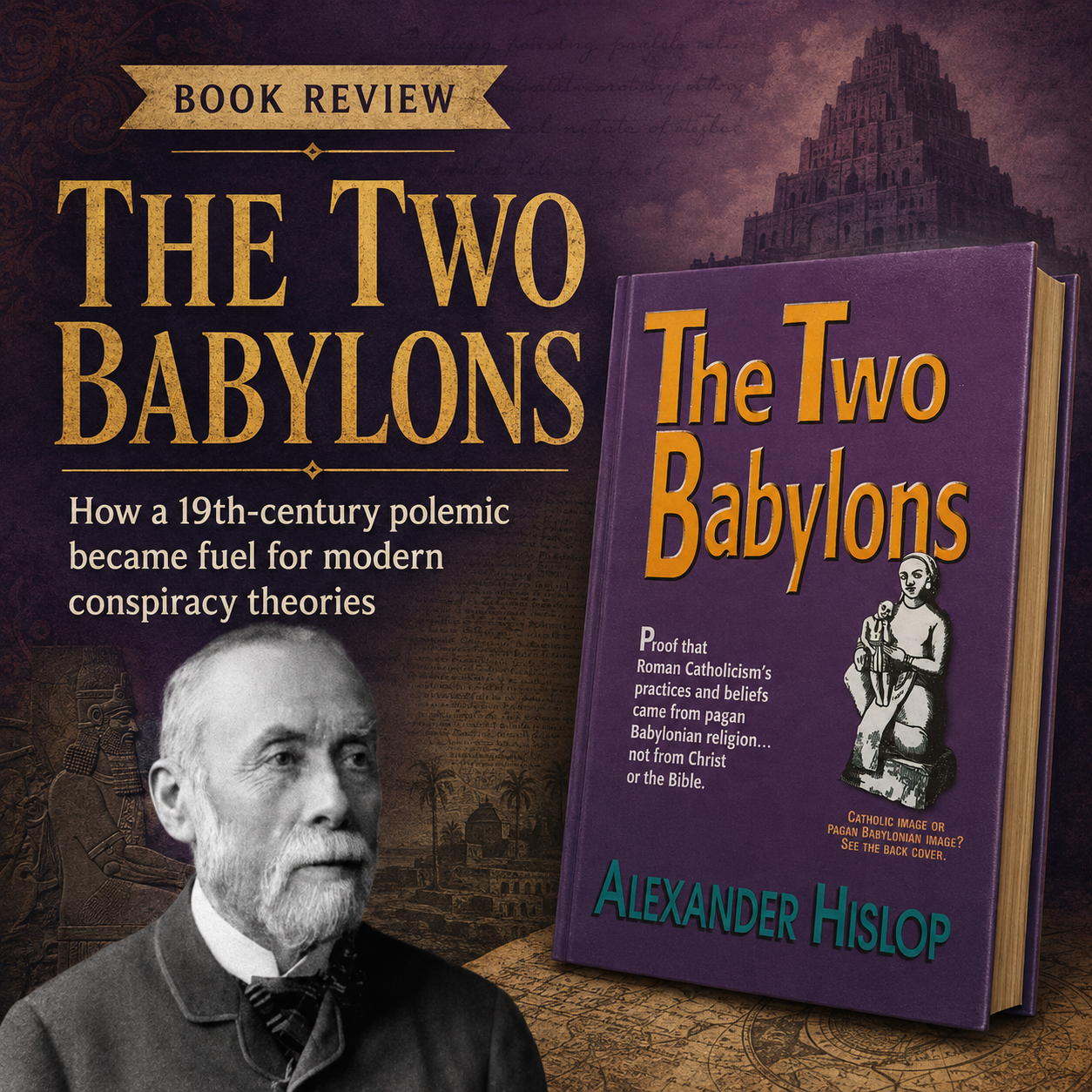
The Two Babylons by Alexander Hislop: When Footnotes Become a Conspiracy Machine
Few books have caused as much confusion in modern Christian conspiracy circles as Alexander Hislop’s The Two Babylons. It is confidently written, heavily footnoted and packed with ancient names, religious symbols, mysterious connections and dramatic claims.
At first glance, it looks like serious historical research.
Unfortunately, appearances can be deceiving.
Originally published as a pamphlet in 1853 and later expanded into a full book, The Two Babylons argues that the Roman Catholic Church is essentially the ancient religion of Babylon disguised in Christian clothing. Hislop attempts to connect the papacy, Marian devotion, religious festivals, symbols and numerous Catholic practices to an ancient system supposedly established by Nimrod and his wife, Semiramis.
It is a breathtaking theory.
It is also built largely upon speculation, forced similarities, questionable etymology and historical connections that Hislop never adequately proves.

The argument of the book
Hislop’s central claim is that there are effectively “two Babylons.”
The first is ancient Babylon, which he presents as the birthplace of organised false religion. The second is the Roman Catholic system, which he believes secretly preserved Babylonian religion while replacing the names of pagan gods with Christian names.
According to Hislop, Nimrod became the model behind a wide variety of male gods and heroes found across different civilisations. Semiramis supposedly became the original “Queen of Heaven,” while her child became the pattern behind numerous mother-and-child religions.
From there, Hislop draws connections between figures such as Nimrod, Osiris, Baal, Bacchus, Saturn, Mithra, Adonis and several others. He performs a similar exercise with Semiramis, identifying her with goddesses such as Venus, Diana, Astarte, Isis and many more.
This is where the book becomes both fascinating and deeply unreliable.
Hislop does not merely argue that ancient religions sometimes shared similar themes. He attempts to collapse radically different cultures, languages, periods and mythologies into one enormous worldwide religious conspiracy.
Similarity becomes identity.
Parallel becomes proof.
Possibility becomes certainty.
Why the book feels convincing
The great strength of The Two Babylons is not the quality of its evidence. Its strength is its presentation.
The book contains an enormous number of names, quotations, illustrations and footnotes. Most readers will not own Hislop’s nineteenth-century sources, understand the original languages or have enough knowledge of Assyrian, Babylonian, Greek, Egyptian and Roman religion to check every claim.
The result is an information imbalance. Hislop appears to know everything, while the average reader has no practical way to challenge him.
A footnote, however, does not automatically make a statement true. A writer may quote a real source while misunderstanding it, removing it from its historical setting or using it to support a conclusion that the source itself never made.
That is one of the central problems with this book: it creates the appearance of accumulated evidence without consistently establishing the historical relationships upon which its conclusion depends.
The Nimrod and Semiramis problem
The subtitle of the book claims that papal worship is really “the worship of Nimrod and his wife.”
That claim should immediately require Hislop to establish several basic facts. Who exactly was Nimrod historically? Was Semiramis his wife? Did they live during the same period? Was Tammuz their child? Can this religious family be found in ancient Babylonian documents?
Hislop does not successfully establish these things.
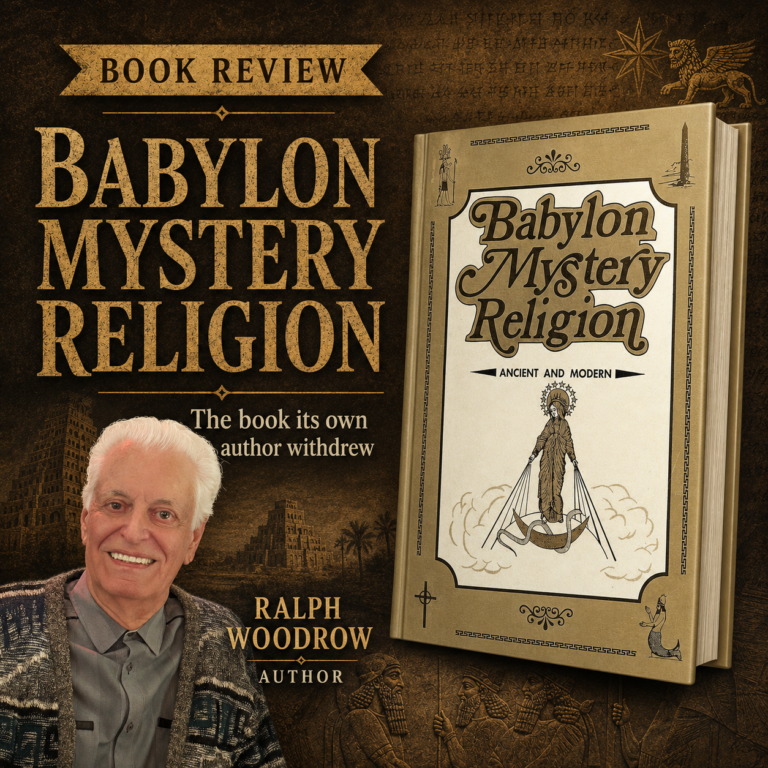
Ralph Woodrow, who once accepted Hislop’s thesis and wrote the popular Babylon Mystery Religion based upon it, eventually returned to the sources and discovered that recognised historical reference works did not support the supposed marriage between Nimrod and Semiramis. Woodrow concluded that Hislop had arbitrarily combined stories from unrelated cultures and periods.
Modern criticism has similarly pointed out that Hislop’s identification of the legendary Ninus with the biblical Nimrod depends upon a defective understanding of ancient Babylonian history. Semiramis is not presented as Nimrod’s wife in the relevant ancient material, nor is she established as the mother of Tammuz.
Once this foundation collapses, much of the rest of the book collapses with it.
Hislop’s method: collect, compare and combine
Hislop’s basic method may be summarised as follows:
Find two figures from different cultures with one or two similarities. Suggest that their names might have related meanings. Ignore major differences between their stories. Then declare that they are different versions of the same original Babylonian figure.
Using this method, almost anything can be connected to anything else.
Two religions use water? One must have borrowed baptism from the other.
Two cultures contain a mother holding a child? They must both preserve the religion of Semiramis.
A symbol resembles a cross? It must come from Babylon.
Two names sound vaguely similar in English? They must share the same ancient origin.
But resemblance is not evidence of direct historical dependence. Human societies naturally reuse common images: mothers and children, light and darkness, water and cleansing, death and life, kingship, fertility, harvest, stars and the sun.
To prove borrowing, a historian must establish more than a visual or verbal similarity. There should be credible evidence of contact, transmission, chronology and development.
Hislop repeatedly skips those steps.
The conspiracy theorists’ favourite history book
This is where The Two Babylons has become particularly dangerous.
Online conspiracy theorists have hijacked the book and present its claims as if they were settled historical facts. A dramatic quotation is removed from its original context, placed over an image of an ancient statue and uploaded with words such as:
“The truth they never taught you.”
Suddenly, every Christian symbol is secretly pagan. Every holiday is Babylonian. Every church tradition is evidence of infiltration. Anyone who disagrees has either been deceived or is supposedly protecting the conspiracy.
Hislop’s method is perfectly suited to social media because it produces shocking conclusions quickly. It offers people the intoxicating feeling that they have discovered hidden knowledge overlooked by ordinary Christians, pastors, historians and scholars.
The book has influenced groups ranging from committed but poorly informed Christians to radical religious movements and sectarian organisations. Woodrow himself described how Hislop’s ideas circulated among both sincere believers and groups such as the Jehovah’s Witnesses.
This is not careful discernment. It is suspicion marketed as spiritual insight.
Many online teachers who quote Hislop have never checked his sources. Some have probably never read the entire book. They merely repeat claims copied from another video, meme, sermon or website.
Ironically, people who warn Christians not to follow “man-made traditions” often end up accepting the theories of one nineteenth-century minister without verifying them.
That is not sola Scriptura.
That is sola Hislop.
The damage it causes
The greatest problem with The Two Babylons is not simply that it gets pieces of ancient history wrong.
The book trains its readers to reason badly.
It teaches them that similarities prove borrowing, that obscure etymologies prove conspiracies and that a large quantity of references is more important than the quality of those references.
It can also lead Christians into endless fear and suspicion. Instead of asking whether a belief is biblical, they become obsessed with discovering whether an object, word, date or custom was ever used by a pagan.
But pagans have used water, bread, music, candles, buildings, rings, robes, calendars and countless other ordinary things. Pagan use does not permanently contaminate an object or practice.
The question is not merely, “Has a pagan ever done something similar?”
The proper questions are: What does this practice mean in its present context? What does Scripture teach? Is the supposed historical connection demonstrable? Are we dealing with actual dependence, or merely resemblance?
Failure to ask those questions leads people away from responsible biblical study and into an imaginary world where Babylon is hiding behind almost everything.
This is not a defence of Roman Catholicism
Rejecting Hislop’s bad history does not require us to accept every Roman Catholic doctrine.
A Protestant may still disagree strongly with the papacy, Marian dogmas, the invocation of saints, the nature of the Mass, priestly celibacy and numerous other Catholic teachings.
But those doctrines should be evaluated through Scripture, responsible theology and verifiable history.
As Woodrow later recognised, the Bible itself provides a far stronger basis for examining doctrinal error than imaginative stories about Nimrod and Semiramis.
Bad arguments do not become good arguments simply because they are aimed at something with which we disagree.
Truth does not need fabricated evidence.
The intellectual honesty of Ralph Woodrow
One of the most valuable parts of this story is what happened after Ralph Woodrow discovered the problems in Hislop’s work.
Woodrow had helped popularise many of these ideas through his own book, Babylon Mystery Religion. When he began checking Hislop’s claims more carefully, he withdrew the earlier book and published The Babylon Connection? in 1997, challenging the theory he had previously promoted.
That deserves respect.
It takes intellectual honesty to admit that an argument you once preached, printed and distributed was mistaken.
Woodrow’s example is far healthier than the behaviour commonly seen online, where conspiracy teachers simply double down when their sources are disproved. Rather than correcting themselves, they accuse critics of being compromised, deceived or part of the conspiracy.
A belief that explains away all criticism can never be properly tested.
Is the book worth reading?
Yes—but not as a reliable guide to ancient religion or church history.
The Two Babylons is worth reading as a historical example of nineteenth-century Protestant polemics and as a case study in poor historical methodology. It demonstrates how a clever writer can construct an impressive theory by combining real quotations, speculative etymologies, unrelated myths and selective evidence.
Readers should approach it with a notebook, a sceptical eye and access to modern historical resources.
Do not assume a claim is true because it has a footnote.
Do not assume two things share an origin because they look similar.
Do not accept a historical connection unless the author can demonstrate how, when and where that connection developed.
Most importantly, never allow a conspiracy theory to replace the careful reading of Scripture.
Final verdict
Historical interest: 3/5
Writing and presentation: 3/5
Reliability as history: 1/5
Overall rating: 2/5
The Two Babylons is confident, dramatic and influential—but it is not dependable scholarship.
Its greatest modern legacy may be the army of online conspiracy theorists who quote it without understanding its sources, repeat its claims without testing them and lead sincere Christians into confusion. What they present as hidden knowledge is often little more than nineteenth-century speculation recycled through twenty-first-century social media.
Christians should be willing to question traditions. We should expose false doctrine and examine historical claims carefully.
But discernment must work in both directions.
We must test not only the traditions we oppose, but also the accusations made against them.
Truth has nothing to fear from investigation. Conspiracy theories do.