

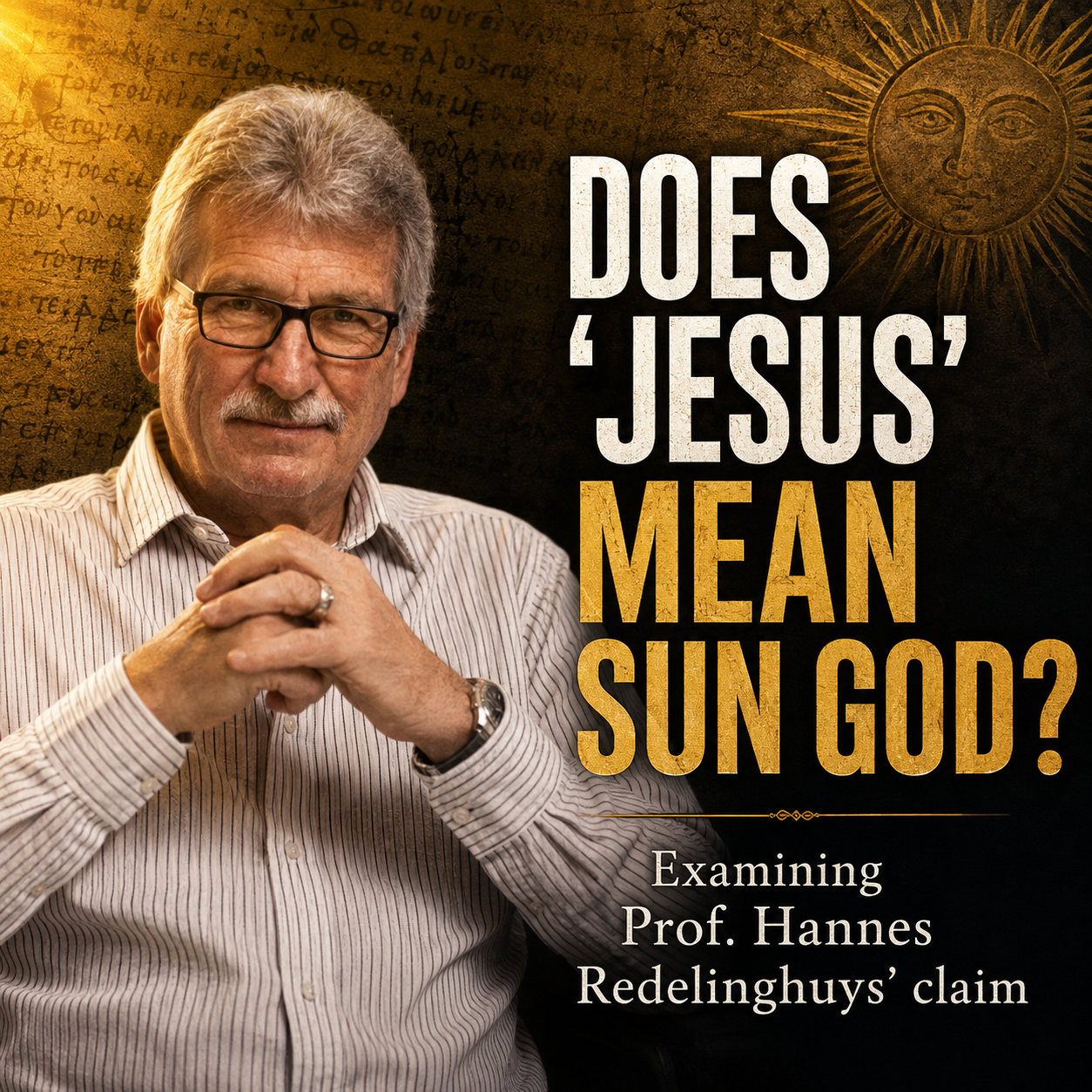
Does the Name “Jesus” Mean “Sun God”? A Response to Professor Hannes Redelinghuys
Professor Hannes Redelinghuys has claimed that the name Jesus means “sun god.” That is a serious claim. And like all serious claims, it should be tested — not by emotion, mockery, or repetition, but by history, language, and evidence.
The short answer is simple:
No, the name Jesus does not mean “sun god.”
That claim is false.
What makes it more troubling is that this idea is not new, original, or scholarly. It comes from a long line of bad etymology, pseudo-history, and recycled internet mythology.
Let’s examine it carefully.
1. What does the name “Jesus” actually mean?
The English name Jesus comes from the Greek Iēsous (Ἰησοῦς), which comes from the Hebrew/Aramaic Yeshua (יֵשׁוּעַ), a shortened form of Yehoshua (יְהוֹשֻׁעַ).
That name means:
“Yahweh saves” or “The LORD is salvation.”
This is not speculation. It is the standard historical and linguistic explanation of the name.
That is also why Matthew 1:21 says:
“You shall call his name Jesus, for he will save his people from their sins.”
The name is tied directly to salvation, not to the sun, not to pagan deity worship, and not to some hidden mystery religion.
2. How did Yeshua become Jesus?
This is where many people get confused.
The New Testament was written in Greek, not Hebrew. When Hebrew names were carried over into Greek, they were often transliterated — that is, their sounds were represented as closely as possible in Greek letters.
So:
- Yehoshua / Yeshua became Iēsous in Greek
- Iēsous became Iesus in Latin
- Iesus became Jesus in English
That is a normal historical language process.
It is no different in principle from:
- Yirmeyahu becoming Jeremiah
- Yeshayahu becoming Isaiah
- Miryam becoming Mary
Languages change the way names are spelled and pronounced. That does not change their meaning.
3. Why the “sun god” claim fails
The claim fails for several reasons.
A. There is no linguistic basis for it
There is no credible lexical, grammatical, or historical evidence that Jesus means sun god.
No serious Greek lexicon says that.
No standard Hebrew source says that.
No competent etymology supports it.
It is simply asserted — usually very loudly — but never demonstrated.
B. “Jesus” is not derived from a pagan god’s name
One common version of the myth says the name Jesus comes from Zeus.
That is nonsense.
The Greek name for Zeus is Zeus (Ζεύς).
The Greek form of Jesus is Iēsous (Ἰησοῦς).
These are not the same word, do not share the same origin, and do not mean the same thing.
People often try to force a connection by noticing that parts of the words may look vaguely similar in English transliteration, but this is not how etymology works. Similar-looking letters do not prove shared meaning.
That is like saying two English words must be related because they happen to contain some of the same letters.
C. The Septuagint destroys the theory
One of the easiest ways to refute this myth is to look at the Septuagint — the ancient Greek translation of the Old Testament.
In the Septuagint, the name Joshua is also rendered as Iēsous.
That is crucial.
Why? Because it proves that Iēsous was the standard Greek way of representing the Hebrew name Yehoshua/Yeshua long before modern conspiracy theories came along.
So if someone says “Jesus means sun god,” they must also explain why Joshua in Greek would suddenly mean sun god too.
The claim collapses immediately.
4. So where does this claim come from?
This is the important part.
The idea that the name Jesus is pagan, corrupt, or connected to a sun god usually comes from a mix of the following sources:
1. Sacred Name and fringe Hebrew Roots movements
Certain fringe groups insist that only a reconstructed Hebrew pronunciation is acceptable, and that forms like Jesus are corrupt, pagan, or satanic.
These groups often make sweeping claims without proper historical method. Instead of working carefully through Hebrew, Greek, manuscript evidence, and the history of language, they rely on suspicion, symbolism, and emotional rhetoric.
That is often where people first hear the claim.
2. Pseudo-historical works like The Two Babylons
A lot of modern “everything is pagan” arguments can be traced back, directly or indirectly, to works like Alexander Hislop’s The Two Babylons.
That book has had enormous influence in popular anti-Catholic and anti-traditional circles, but it is widely criticized for loose associations, poor method, and forcing pagan parallels where they do not belong.
It helped popularize the habit of claiming that Christian beliefs, names, and symbols all secretly come from pagan religion — even when the evidence is weak or nonexistent.
3. Internet mythology and bad etymology
In more recent years, this claim has spread through:
- YouTube videos
- meme theology
- anti-church polemics
- amateur “Hebrew” teachers
- conspiracy-driven social media posts
One popular myth says Iēsous means something like “Hail Zeus.”
That is false.
Another says that because Christians use terms like Son of God, this somehow became Sun god through hidden paganism. Again, that is not linguistics — that is wordplay pretending to be scholarship.
The claim survives because it sounds dramatic, not because it is true.
5. The real issue: sound bites vs scholarship
This is what happens too often in online theology.
A sensational claim is made.
People are shocked.
It sounds deep.
It sounds hidden.
It sounds like secret knowledge.
But when you ask for actual evidence — grammar, lexicons, manuscript history, Greek usage, Hebrew roots, ancient sources — the claim has nothing solid behind it.
That is exactly the case here.
If someone wants to argue that the name Jesus means sun god, then they need to do more than say it confidently. They need to prove it.
They must show:
- the Hebrew root,
- the Greek evidence,
- the lexical support,
- the historical chain,
- and the ancient usage.
And they cannot.
Because the claim is false.
6. What the evidence actually shows
The evidence shows:
- Jesus comes from Iēsous
- Iēsous is the Greek form of Yeshua / Yehoshua
- Yeshua / Yehoshua means “Yahweh saves”
- the name has nothing to do with a sun god
- the “sun god” theory comes from fringe speculation, not sound scholarship
That is the bottom line.
Conclusion
Professor Hannes Redelinghuys is free to make public claims. But public claims must be open to public scrutiny.
And this claim fails scrutiny.
The name Jesus does not mean sun god.
It is not a pagan title.
It is not secretly derived from Zeus.
It is not a hidden code from sun worship.
It is the historical English form of the name that comes through Hebrew -> Greek -> Latin -> English, and its meaning is tied to salvation:
“Yahweh saves.”
That is not pagan mythology.
That is basic historical linguistics.
And if we care about truth, then we should prefer evidence over sensation, and sources over slogans.




Dankie Arend het jy YouTube videos