
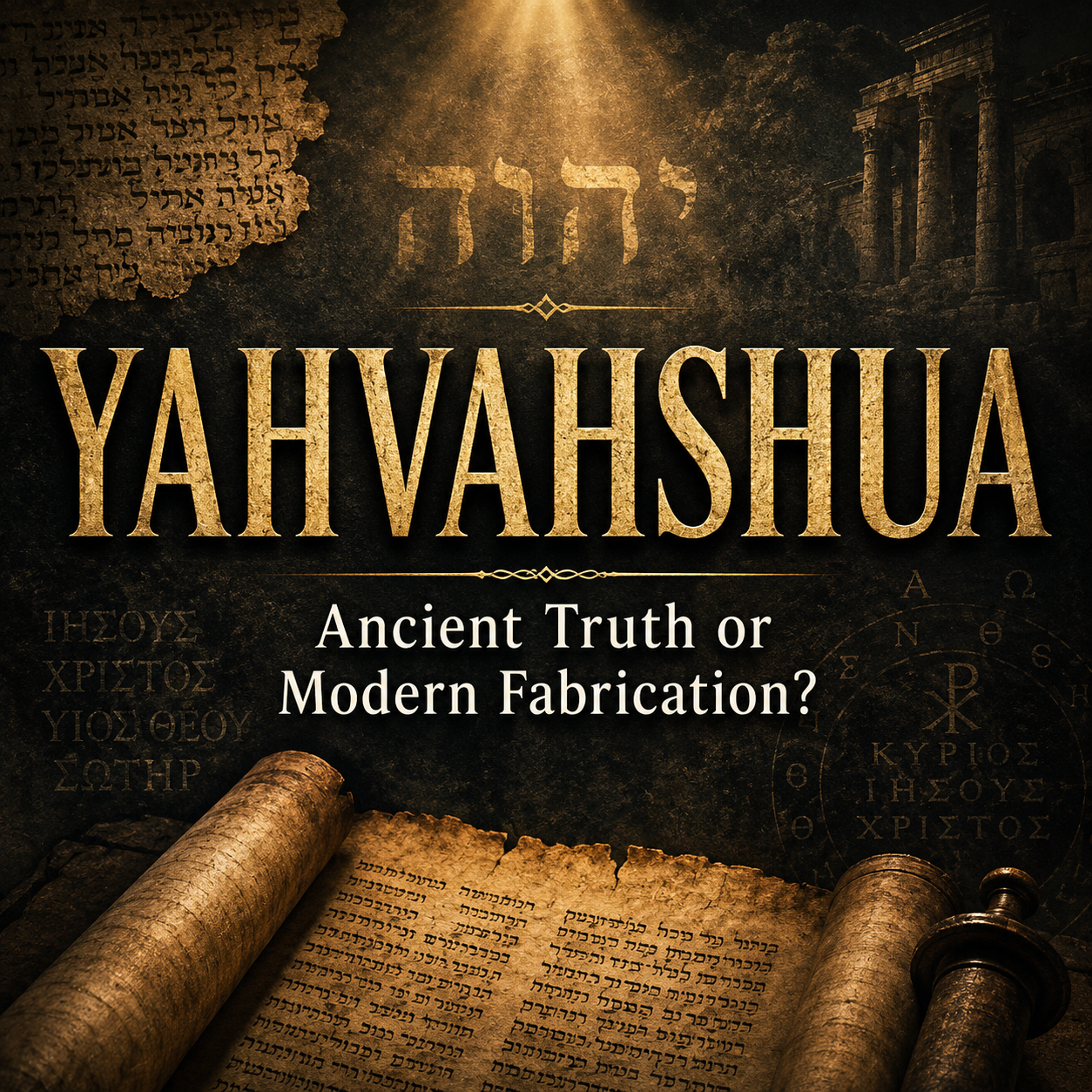
YAHVAHSHUA: Exposing a Modern Fabrication
By Arend Botha
In certain corners of the Sacred Name Movement, an unusual claim is presented as a recovered ancient truth: Jesus was supposedly not called Jesus, Yeshua, or even Yehoshua, but “Yahvahshua.”
The claim is often delivered with great confidence. Believers are told that “Yahvahshua” is the Messiah’s complete and original Hebrew name, that ordinary Bible translations have removed it, and that using names such as “Jesus” may represent ignorance, corruption, or even disobedience.
But confidence is not evidence.
When “Yahvahshua” is examined historically, textually, and linguistically, the claim collapses. The name is not found in the Hebrew Scriptures, the Dead Sea Scrolls, ancient Jewish inscriptions, the Septuagint, the Greek New Testament manuscripts, or the writings of early Jewish and Christian authors.
It is not an ancient name rediscovered in modern times.
It is a modern religious construction.
The Basic Question: Where Is the Evidence?
Anyone claiming that “Yahvahshua” was the Messiah’s original name carries the responsibility of producing evidence.
Where does the name appear in an ancient Hebrew manuscript?
Where is it found in a first-century Jewish inscription?
Where does it appear in the Dead Sea Scrolls?
Where is it used by Josephus, Philo, the apostles, or the early Christian writers?
Where does it appear in any surviving Greek New Testament manuscript?
These are straightforward historical questions. Yet advocates of the name cannot produce an ancient source containing it.
Instead, the argument normally begins with a theological assumption: because the Father’s name is represented by the four Hebrew consonants יהוה—YHWH—the Messiah’s name must contain a particular pronunciation of those consonants. The form “Yahvah” is then joined to part of a Hebrew word associated with salvation, producing “Yahvahshua.”
But constructing a word from selected religious ideas is not the same as discovering an ancient personal name.
A name cannot be declared ancient merely because someone believes its individual parts carry theological significance. Historical names must be demonstrated from actual historical usage.
What Was the Hebrew Name of Jesus?
The historically recognised Hebrew or Aramaic form of Jesus’ name is Yeshua, written ישוע.
Yeshua was a shortened form of the older Hebrew name Yehoshua, written יהושע, from which English receives the name Joshua. Both forms were used among Jewish people, and the shorter form appears repeatedly in the post-exilic books of the Hebrew Bible, particularly Ezra, Nehemiah, and Chronicles.
For example, the Hebrew text uses Yeshua as the name of several individuals after the Babylonian exile. Nehemiah 8:17 even uses the shortened form when referring to Joshua son of Nun, who is elsewhere called Yehoshua.
This demonstrates something extremely important: Yeshua was not invented by Christians, Catholics, Greeks, or modern Bible translators. It is an authentic Jewish name found in the Hebrew Scriptures themselves.
It was also a common Jewish name during the Second Temple period. Ancient Jewish sources and inscriptions preserve both Yeshua and related forms of Yehoshua. The available evidence therefore fits naturally with Jesus of Nazareth having been known among his Jewish contemporaries as Yeshua. citeturn900081search1turn900081search4
By contrast, there is no comparable ancient evidence for “Yahvahshua.”
From Yeshua to Iēsous
The Greek New Testament calls Jesus Ἰησοῦς — Iēsous.
Sacred Name teachers sometimes treat this Greek form as evidence that the Messiah’s true name was corrupted. But Iēsous was not created by hostile Christians attempting to conceal a Hebrew name. Greek-speaking Jews were already using Iēsous as the established Greek form of Yehoshua and Yeshua before the New Testament was written.
The Septuagint—the ancient Jewish translation of the Hebrew Scriptures into Greek—regularly renders Joshua’s Hebrew name as Iēsous. This translation was produced by Jewish translators, not by later Roman Catholics or medieval church authorities.
This can even be seen inside the New Testament.
In Acts 7:45 and Hebrews 4:8, the Greek text uses Iēsous when referring to Joshua son of Nun, not Jesus of Nazareth. Some older English Bibles, including the King James Version, consequently use “Jesus” in these passages, while modern translations use “Joshua” to prevent confusion.
The same Greek name could represent both Jesus and Joshua because both names travel through the same linguistic history:
Yehoshua → Yeshua → Iēsous → Iesus → Jesus
This is not evidence of corruption. It is the normal process by which a name passes from one language into another.
Greek did not possess every sound found in Hebrew. It had no direct equivalent for the Hebrew “sh” sound, and Greek masculine names were commonly given grammatical endings that allowed them to be declined. The result was Iēsous, an established Greek representation of the Jewish name long before Christianity became a powerful institution. citeturn900081search1turn900081search8
“Jesus” Is Not Derived from Zeus
Another claim frequently attached to Sacred Name teaching is that “Jesus” supposedly means “hail Zeus” or was created from the name of the Greek god Zeus.
This claim has no linguistic foundation.
The Greek forms are visibly and historically different:
- Jesus: Ἰησοῦς — Iēsous
- Zeus: Ζεύς — Zeus
They do not share the same spelling, origin, grammatical formation, or meaning.
The English name “Jesus” came through the Latin Iesus, which came from the Greek Iēsous, which represented the Hebrew or Aramaic Yeshua. The change from an initial “I” to the modern English “J” resulted from the later development of European spelling and pronunciation.
No pagan deity needs to be inserted into that history.
The “Jesus equals Zeus” argument depends on a vague similarity in the sound of two English pronunciations while ignoring the actual Greek spelling and the documented transmission of the name through Hebrew, Greek, Latin, and English.
That is not linguistic scholarship. It is wordplay.
The Sacred Name Movement
The modern promotion of forms such as “Yahshua,” “Yahushua,” and “Yahvahshua” is closely connected to the twentieth-century Sacred Name Movement.
Sacred Name groups generally argue that believers should pronounce particular Hebrew forms of the names of God and the Messiah. Some go further and teach that salvation, correct worship, baptism, or membership in the true people of God depends upon using their preferred pronunciation.
The problem is that the movement has never agreed on what that supposedly essential pronunciation should be.
Depending on the group, one may encounter:
- Yahweh
- Yahveh
- Yahvah
- Yahuwah
- Yahuah
- Jehovah
- Yahshua
- Yahushua
- Yahusha
- Yahvahshua
These competing forms reveal a central weakness in the movement’s claim. If the precise pronunciation is essential for salvation or acceptable worship, why can those claiming to have restored it not agree on what it is?
Peter Unseth’s study of English Sacred Name Bible translations documents the growth of numerous competing translations, each introducing its preferred forms into the biblical text. Rather than representing a single ancient tradition, these versions demonstrate considerable modern variation and disagreement. citeturn251691search0turn251691search36
Angelo B. Traina and the Rise of Sacred Name Bibles
Angelo B. Traina was one of the most influential figures in the development of Sacred Name Bible translation.
In 1950, Traina published The New Testament of Our Messiah and Saviour Yahshua. In 1963, he published The Holy Name Bible, a revision based substantially on the King James Version that replaced traditional English titles and names with Traina’s preferred Sacred Name forms.
Traina’s work helped establish the pattern followed by later Sacred Name translations: begin with an existing English Bible and systematically replace words such as “Lord,” “God,” “Jesus,” and “Christ” with selected Hebrew or Hebrew-sounding alternatives. Library records identify Traina’s complete Holy Name Bible as a 1963 publication of the Scripture Research Association. citeturn251691search9turn251691search10
However, an important distinction must be made.
Traina’s version predominantly promoted “Yahshua,” not “Yahvahshua.” He also did not publish the later Restoration of Original Sacred Name Bible.
Traina’s work laid the foundation for the Sacred Name Bible tradition, but the more elaborate form “Yahvahshua” became associated with later figures and publications operating within the movement he helped popularise.
The Restoration of Original Sacred Name Bible
The Restoration of Original Sacred Name Bible was produced by Missionary Dispensary Bible Research and published in editions during the 1970s. Library catalogues record editions associated with 1973 and 1976. It was based largely on J. B. Rotherham’s Emphasized Bible, but revised according to the editors’ Sacred Name theology. citeturn251691search2turn251691search11turn251691search21
This publication used “Yahvah” for God and presented “Yahvahshua” as the supposed fuller name of the Messiah, while frequently using “Yahshua” as an abbreviated form.
That claim creates an immediate problem.
If “Yahvahshua” were genuinely the original name, why would a Bible claiming to restore the original name repeatedly replace it with an alleged abbreviation?
More importantly, where did the editors obtain “Yahvahshua”?
They did not obtain it from the Hebrew manuscripts of the Old Testament.
They did not obtain it from the Greek manuscripts of the New Testament.
They did not obtain it from the Septuagint.
They did not obtain it from ancient Jewish inscriptions.
They did not obtain it from the Dead Sea Scrolls.
The name was produced by combining a disputed modern pronunciation of the divine name—“Yahvah”—with elements associated with the Hebrew concept of salvation.
That is construction, not restoration.
Why “Yahvahshua” Fails Linguistically
The older Hebrew name Yehoshua already contains a recognised divine element together with the Hebrew root connected to salvation or deliverance.
Hebrew personal names frequently contain shortened forms of divine names. These forms follow recognisable historical patterns. They are not created by inserting a preferred modern pronunciation of the complete Tetragrammaton into another word.
The historically attested forms are Yehoshua and Yeshua.
“Yahvahshua” does not represent the normal contraction of Yehoshua. In fact, the opposite has occurred: a considerably longer form has been manufactured and then declared to be the original from which the genuinely ancient form supposedly came.
That reverses the evidence.
We possess examples of Yeshua.
We possess examples of Yehoshua.
We possess the Greek Iēsous.
We do not possess ancient examples of Yahvahshua.
One cannot take an unattested modern construction and use it to redefine names that are documented in ancient sources.
“I Have Come in My Father’s Name”
Some Sacred Name advocates appeal to John 5:43:
“I have come in my Father’s name.”
They argue that Jesus must therefore have carried the complete pronunciation of the Father’s name within his personal name.
But this misunderstands the biblical expression “in the name of.”
To come in someone’s name means to come with that person’s authority, commission, character, or representation. It does not mean that the person’s name must be physically inserted into your own.
A prophet could speak in the name of the Lord without changing his personal name. David confronted Goliath “in the name of the LORD of hosts” in 1 Samuel 17:45, yet the word YHWH was not added to the front of “David.”
Christ came in the Father’s name because he was sent by the Father, revealed the Father, performed the Father’s works, and possessed the Father’s authority.
John 5:43 is a statement about authority and mission—not a Hebrew spelling lesson.
Does Salvation Depend on Hebrew Pronunciation?
The New Testament was written and circulated in Greek. In those inspired writings, the apostles proclaimed Iēsous Christos—Jesus Christ.
They preached the Gospel throughout multilingual communities without demanding that every convert master a reconstructed Hebrew pronunciation. Greek-speaking believers called upon Iēsous. Latin-speaking Christians later used Iesus. Christians in other nations received the same name in the ordinary forms of their languages.
The authority does not lie in producing identical sounds with identical accents.
The authority lies in the person being named.
Romans 10:13 declares that everyone who calls upon the name of the Lord will be saved. In the biblical world, a person’s “name” represents his identity, authority, reputation, and revealed character. Calling upon Christ’s name means trusting in and appealing to the true Christ proclaimed in the Gospel.
A person can pronounce the syllables “Yeshua” perfectly while believing in a false Messiah. Another can say “Jesus” with a strong accent while placing genuine faith in the crucified and risen Son of God.
Salvation is not a pronunciation test.
A Manufactured Crisis
The Sacred Name controversy often creates a crisis where Scripture creates none.
Believers are told that their Bibles have been corrupted, that the name of their Saviour has been hidden, and that prayers offered in the name of Jesus may be invalid. A modern spelling is then presented as the solution to the fear created by the same movement promoting it.
But the evidence tells a simpler story.
Jesus was a Jewish man bearing the historically authentic name Yeshua. Greek-speaking Jews and Christians rendered that name Iēsous. Latin speakers received it as Iesus. English eventually received the form Jesus.
Nothing sinister is required to explain this development.
It is ordinary linguistic history.
Ironically, the people accusing the historic biblical text of corruption are often the ones inserting words into Scripture that are absent from every surviving New Testament manuscript.
The Greek manuscripts say Iēsous.
The Hebrew evidence supports Yeshua and Yehoshua.
Only the modern Sacred Name publications say Yahvahshua.
Conclusion: Sources Before Assertions
“Yahvahshua” is not the lost name of the Messiah.
It is not found in the ancient biblical manuscripts.
It is not supported by recognised Hebrew name formation.
It is not required by John 5:43.
It was not used by the apostles.
It arose within the modern Sacred Name environment and was promoted through later revisions such as the Restoration of Original Sacred Name Bible.
The historically defensible Hebrew name is Yeshua, related to the longer Yehoshua. The inspired Greek New Testament faithfully gives us Iēsous, from which the English name Jesus developed through Latin.
Christians are free to call him Yeshua. They are equally free to call him Jesus. Neither pronunciation possesses magical power, and neither language has a monopoly on the Gospel.
The power is not hidden inside a reconstructed arrangement of syllables.
The power belongs to the person himself:
Jesus Christ—Yeshua the Messiah—the crucified and risen Lord.
The Church does not need a name invented in the twentieth century.
It needs the Christ proclaimed in the first.
Selected Sources
The Greek New Testament, particularly Matthew 1:21, Acts 7:45, Hebrews 4:8, and John 5:43.
Peter Unseth, “Sacred Name Bible Translations in English: A Fast-Growing Phenomenon,” The Bible Translator, Vol. 62, No. 3, 2011, pp. 185–194.
Angelo B. Traina, The New Testament of Our Messiah and Saviour Yahshua, 1950.
Angelo B. Traina, The Holy Name Bible, Scripture Research Association, 1963.
Missionary Dispensary Bible Research, The Restoration of Original Sacred Name Bible, editions published during the 1970s.
A New English Translation of the Septuagint: Iesous, International Organization for Septuagint and Cognate Studies.
The Hebrew texts of Ezra, Nehemiah, Chronicles, Haggai, and Zechariah.