

Edward Irving helped shape the nineteenth-century movement from which several apostolic churches later developed. But was he himself an apostle? The historical answer is no: his office in the emerging movement was that of an “angel”, or bishop. That distinction matters when examining claims about the origins and authority of the Old Apostolic Church.[4]
The OAC’s own public history makes a similar distinction: it identifies John Bate Cardale as the first restored apostle and describes Irving as having been ordained a bishop. Irving belongs to the movement’s formative history; he cannot simply be inserted into a succession of apostles.[6]
A preacher expecting Christ’s return
Irving (1792–1834) was a Scottish Presbyterian minister who moved to London in 1822. His preaching joined a strong emphasis on Christ’s humanity with expectations of renewed spiritual gifts and Christ’s future, physical return.[1]

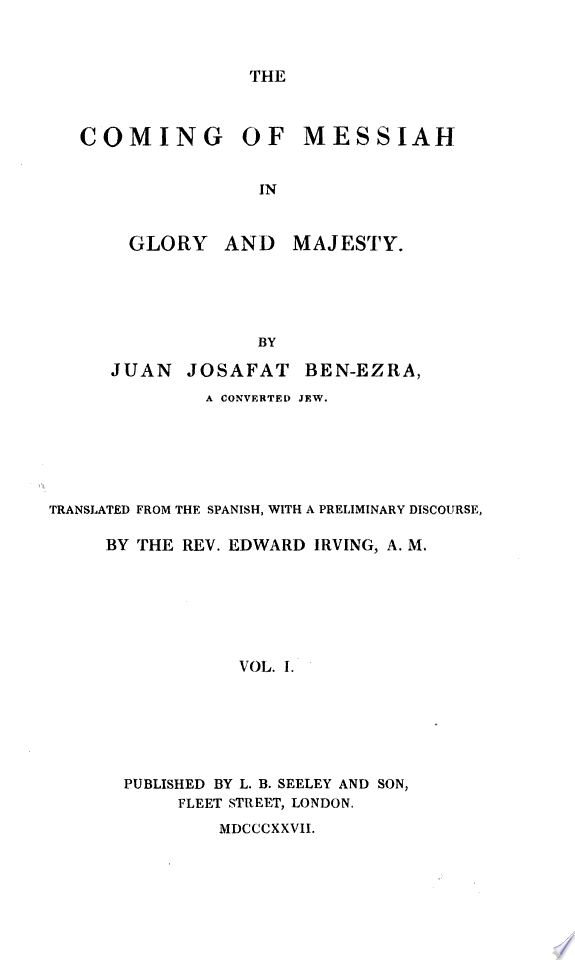
One important publication was the 1827 English translation of Manuel Lacunza’s The Coming of Messiah in Glory and Majesty. Irving translated the work and supplied a substantial preliminary discourse. Lacunza’s authorship and Irving’s role as translator should be kept distinct.[2]
Irving was also involved in the prophetic conferences hosted by the banker Henry Drummond at Albury, beginning in 1826. These meetings brought together people concerned with prophecy and the condition of the churches. The developing movement therefore involved a wider network than Irving’s own congregation.[6]

Why Irving lost his ministry
Two events must be distinguished. In 1832 Irving lost his position at Regent Square, London, amid conflict over the manifestations permitted in worship. On 13 March 1833, the Presbytery of Annan deposed him from the Church of Scotland ministry on a charge concerning his teaching about Christ. Dating that deposition to 1831 confuses the chronology.[1]
The doctrinal dispute also needs fair description. Irving argued that Christ assumed fallen human nature while remaining personally sinless through the Holy Spirit. His opponents rejected that account of Christ’s humanity. Reporting their condemnation is a historical statement; deciding the theological controversy requires examining his argument. Saying simply that Irving taught that Jesus committed sin misrepresents his position.[1]
Cardale, Irving and the restored apostles
John Bate Cardale was recognised as an apostle in 1832. Later recollections differ over the precise day, including 31 October and 7 November. The movement understood his appointment as a prophetic calling from God. A historian can document that belief without treating the divine origin of the calling as an established historical fact.[5]
In April 1833 Cardale ordained Irving as an angel. Here “angel” was the movement’s title for a pastoral or episcopal office; it did not mean a heavenly being. Irving did not become one of the restored apostles.[4]
By 1835 the movement had recognised twelve apostles. Irving had died in 1834. The Catholic Apostolic Church’s developed organisation and worship owed much to Drummond, Cardale and others. Describing Irving as its sole founder hides that shared development; describing him as an influential formative figure is more accurate.[3]
Do not read later sealing practices back into Irving
The developed Catholic Apostolic practice of apostolic sealing was introduced in 1847, more than a decade after Irving’s death. Earlier expectations concerning the Holy Spirit should not automatically be equated with that later rite.
This is more than a critic’s objection. A historical study published by the New Apostolic Church warns that later writers interpreted the events of 1832 through the sealing practice introduced in 1847. Claims that Irving demanded apostles specifically to administer a later form of sealing therefore need a contemporary passage demonstrating that claim.[5]
How the history connects to the OAC
The route from the British movement to later apostolic churches involved disputes and organisational changes. In 1863 the Hamburg congregation separated from the Catholic Apostolic Church after accepting an additional apostolic calling that the existing apostles did not recognise. The New Apostolic Church dates its beginnings to that separation.[7]
A later South African dispute involved Carl Georg Klibbe’s and Wilhelm Schlaphoff’s organisations. The terms of settlement in Case 432/1926 provided for the Old Apostolic name from 1 June 1927. That document helps explain an institutional separation; it does not establish which church possessed divine authority.[8] Read the full explanation of the 1926 settlement and the overview of the movement’s schisms.
These historical relationships deserve investigation. They do not, by themselves, prove that a modern church has preserved every earlier teaching, possesses an uninterrupted divine commission, or reproduces the apostolate described in the New Testament. Those are further claims requiring further evidence.
Compare present teaching with identifiable documents
Care is also needed when contrasting Irving with the present OAC. Its current public Confession of Faith affirms Christ’s deity and humanity and speaks of His coming again in glory to judge the living and the dead. That wording must be acknowledged when assessing claims that the church simply denies His return.[9]
A historical catechism, a current confession and a particular preacher’s explanation are distinct pieces of evidence. If they appear to conflict, identify the document, edition, date and wording, then explain the disagreement. An undated extract should not stand in for every member’s belief or every current official statement.
The question history leaves with us
The central question is how a claim of restored apostleship should be tested. Ephesians 4:11 names apostles among Christ’s gifts to the church; the verse does not identify a particular nineteenth-century claimant. Christians differ over how that ministry continues, and a title alone cannot settle the disagreement.
Scripture also calls believers to examine claims and teachings: Acts 17:11 describes the Bereans checking what they heard, while 1 Thessalonians 5:19–22 joins openness to prophecy with discernment. Applied to this history, that means checking documents, distinguishing testimony from interpretation, and asking what actually supports a claim to speak for God.
Sources and bibliography
Select a numbered citation to preview its source context. Quoted wording is labelled separately from summaries. The links below open the sources themselves; page numbers refer to printed pagination unless otherwise stated.
Historical research and original publications
- Byung-Sun Lee, ‘Christ’s Sinful Flesh’: Edward Irving’s Christological Theology within the Context of his Life and Times, PhD thesis, University of Edinburgh, 2011. Abstract, pp. i–ii; introduction, p. 1; pp. 210–213, 255–257. Open source 1 ↗
- Manuel Lacunza, The Coming of Messiah in Glory and Majesty, vol. 1, translated by Edward Irving, Seeley, 1827. Digitised original edition; title page and preliminary discourse. Primary publication and bibliographic evidence. Open source 2 ↗
- Yale Divinity Library, Catholic Apostolic Church Records, RG 55, historical introduction, PDF pp. 5–6. An archival finding aid with a historical overview, rather than a contemporary eyewitness account. Open source 3 ↗
- Maurice Milne, “‘Gang warily’: Thomas Carlyle and Henry Drummond”, The Carlyle Society, Occasional Papers 23, Edinburgh, 2010, pp. 17–32, especially pp. 20, 25–26. Historical essay hosted by the University of Edinburgh. Open source 4 ↗
- Manfred Henke, 175 Years Ago: The Call of John Bate Cardale and the Contemporary Idea of Apostleship, revised English study, 17 December 2010, published by New Apostolic Church International, pp. 1–5, 16–20. This church-published investigation critically compares sources; its theological conclusions remain the publisher’s faith position. Open source 5 ↗
Church documents and the South African connection
- Old Apostolic Church, History, official public website, sections on shared history, Great Britain and the first twelve apostles. Checked 29 October 2026. Primary evidence of how the OAC describes its origins; claims of divine action are confessional claims. Open source 6 ↗
- New Apostolic Church, Catechism, §11.3.3, “The beginnings of the New Apostolic Church”. Institutional account of the Hamburg separation and the dispute over new apostolic callings. Open source 7 ↗
- Case 432/1926, Terms of Settlement, clauses 3–5, PDF pp. 2–4. Primary document; the available copy contains settlement terms, without a separate reasoned judgment. See the linked companion article for the document’s limits. Open source 8 ↗
- Old Apostolic Church, Confession of Faith, first profession, official public website. Checked 29 October 2026. Primary evidence for the wording of the current public confession; this alone does not establish how every congregation interprets it. Open source 9 ↗
This article develops questions raised in the 2016 post “History – Edward Irving”. It has been independently written and checked against the sources above. The source post’s comments are not used as historical evidence.